
One late autumn night in 1943, two of Denmark’s most prominent architects climbed into a rowing boat on the northern coast of Denmark, preparing to leave their occupied homeland under the cover of darkness. The spotlights of German patrol boats swept across the water as they pushed off from shore.

Arne Jacobsen, Poul Henningsen and their wifes fled the nazis in a rowing boat, 1943 © Public Domain
One of the men who took his place at the oars was Arne Jacobsen, today recognised as one of Denmark’s most influential architects and designers. His extensive and multifaceted oeuvre has since shaped both Danish and international design and architectural history. Even early in his career, Jacobsen played a central role in bringing Modernism to Denmark, helping to forge a distinctly functionalist expression that combined new architectural ideas with established Danish craft traditions.
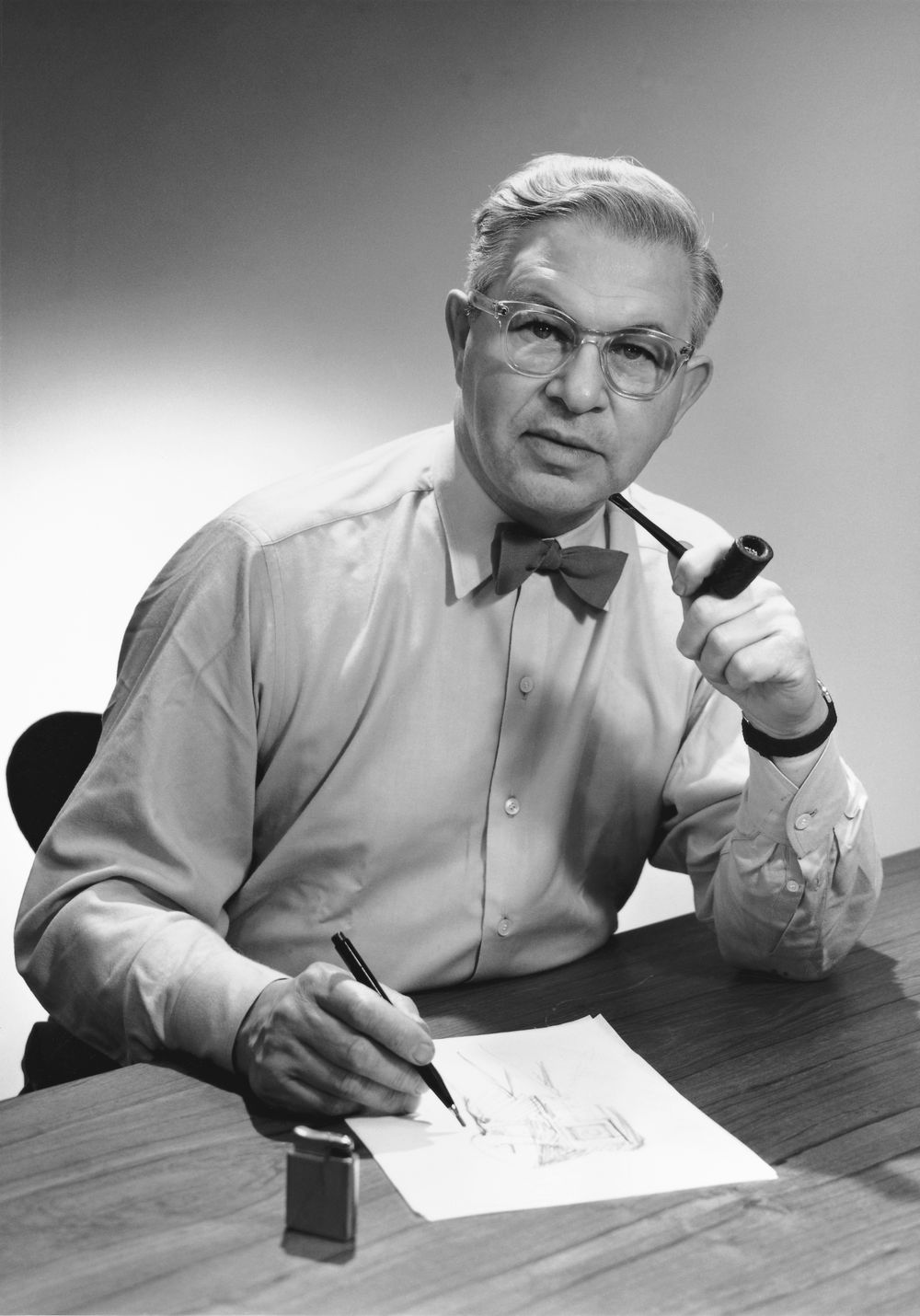
Arne Jacobsen, father of "Ant-Chair" and "Egg-Chair", had Jewish descent, and was therefore threatened by the nazis. © Courtesy of Fritz Hansen
In 1942, Jacobsen completed not one but two Danish town halls – Aarhus City Hall, in collaboration with Erik Møller, and Søllerød Town Hall, designed together with Flemming Lassen. During his work on the latter project, Jacobsen met Jonna Møller, who was responsible for the project’s textiles. They married in 1943 and maintained a close creative partnership throughout their relationship. Jonna was instrumental in translating her husband’s botanical studies and watercolours into textile patterns. But the same year they wed, the couple set out in a rowing boat to flee across the Øresund Strait to neighbouring Sweden.
A Dark Night
On the night between 1 and 2 October 1943, the Nazi secret police – Gestapo – launched a long-planned operation: a sweeping raid targeting all Jewish homes in the Copenhagen area and beyond. Denmark’s Jewish community, however, had been warned, and most had already gone into hiding with friends, in summer houses, guesthouses or hospitals. Within a matter of days, around 7,000 refugees – primarily Danish Jews and outspoken anti-Nazis – had crossed the strait.

Denmark was occupied in 1940, and over 7000 jewish people fled to Sweden.
Among them was Arne Jacobsen. He purchased a rowing boat and set out for Sweden with his wife Jonna and their friends Poul and Inger Henningsen. After a gruelling journey lasting more than five hours – during which, according to some accounts, the women had to take the oars towards the end, as the star architect and the celebrated lamp designer were hardly seasoned rowers – they finally reached the shores of Landskrona, still shrouded in darkness.

Poul Henningsen, remembered for "Artichoke" and "PH-lamp", was in danger due to his political stands and satire. © Courtesy of Louis Poulsen
The second man in the boat had even more strings to his bow. Poul Henningsen had worked as a writer, architect, designer and revue author. By this time, he was already internationally known for his lamps – particularly his patented three-shade system, engineered to maximise the glow of the bulb and distribute light optimally without harsh glare.
Years in Exile
Arne Jacobsen fled occupied Denmark due to his Jewish background. Poul Henningsen, on the other hand, had different reasons: he had long been a vocal critic of Nazism throughout the 1930s, fully aware that his warnings about its growing influence on Danish society would make him a target under occupation.
In Stockholm, Henningsen continued writing satire and began producing lampshades from cardboard and paper – wartime rationing demanded new approaches from a designer so attuned to materials. Once suitable supplies became available, it did not take long before a small collection of pendant, ceiling and table lights went into production.
)
During his time in Sweden, Jacobsen studied nature and created several patterns for Nordiska Kompaniet.
During his years in exile, Arne Jacobsen created a number of nature-inspired patterns that would later inform the organic curves characteristic of his furniture design – visible, for instance, in the Ant and Egg chairs. The Jacobsens began a collaboration with the Swedish department store NK in Stockholm, which put Jacobsen’s patterns into production. Yet this Swedish chapter in his life remains a relatively hidden one – a period that added emotional depth and human warmth to his otherwise minimalist and rational style. His major international breakthrough came only after the war, with projects such as the Søholm Row Houses (1951), and the gesamtkunstwerk SAS Royal Hotel (1960) and St Catherine’s College, Oxford (1962).
The Jacobsen couple returned to Denmark after the end of the war in 1945. Jacobsen, however, returned to Landskrona once more in 1965 to design the city’s sports hall – his only public building in Sweden.
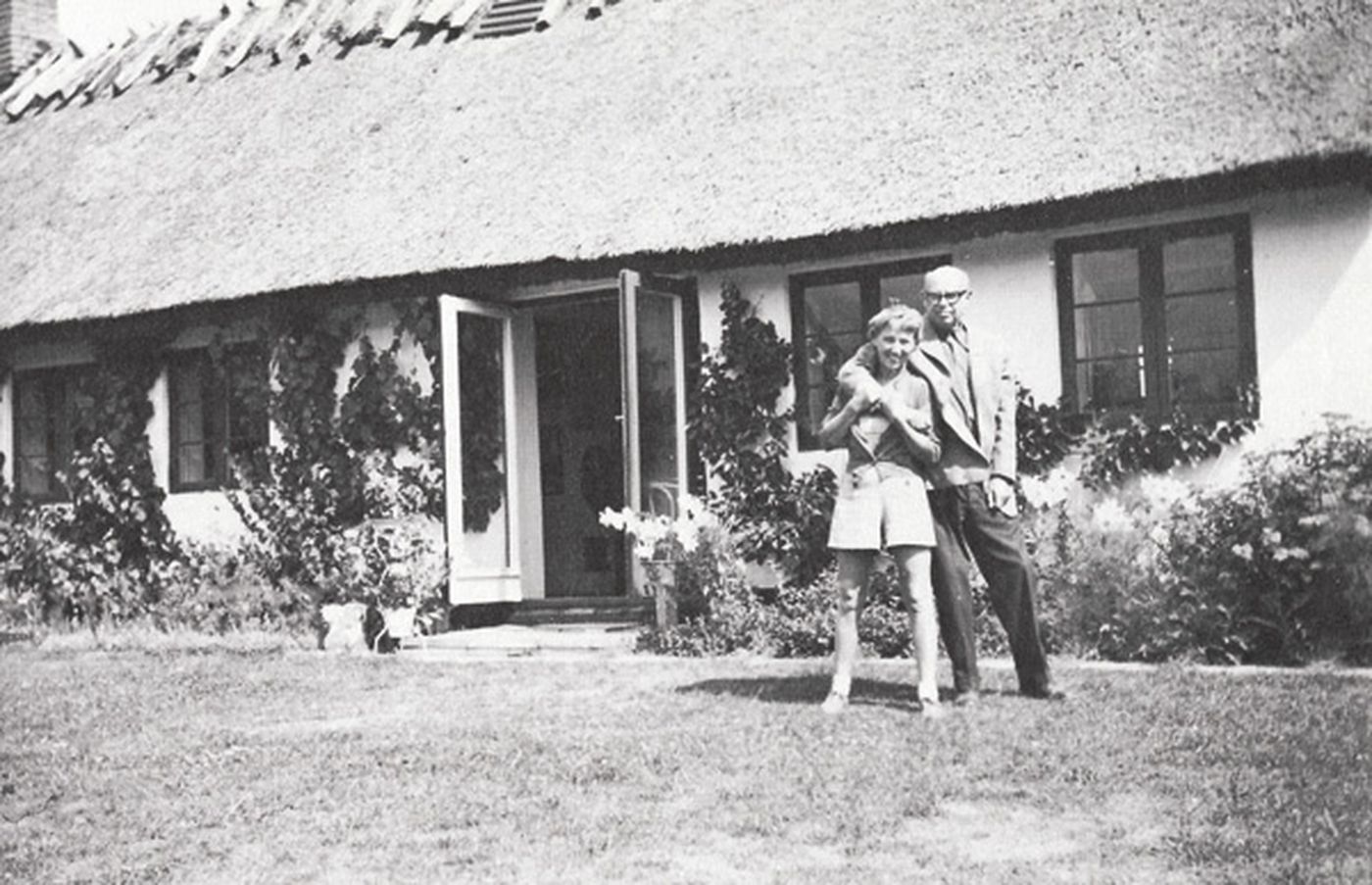
Poul and Inger Henningsen returned to Denmark after the war, here in front of their summer house in 1958 © Public Domain
Unlike his friend, Henningsen had already achieved international acclaim long before their nocturnal escape. In 1926, he had revolutionised the modern lighting industry with his groundbreaking functionalist design, and the PH lamp remains one of the world’s best-selling light fixtures to this day. Poul Henningsen and his wife also returned to Denmark in 1945, where he quickly resumed his sharp-witted commentary in post-war journalism – always with a distinctly functionalist perspective. He eventually became editor of the Danish lighting journal LP-nyt, where he famously led a heated debate against the spread of fluorescent lighting.
Explore design by Arne Jacobsen and Poul Henningsen
)

)
