ERIC PEHAP. Abstract motif, oil on canvas, signed & dated 1973.
This auction is closed, but maybe you like the following items?

Images





Description
Frame dimensions: 62 x 83 cm.
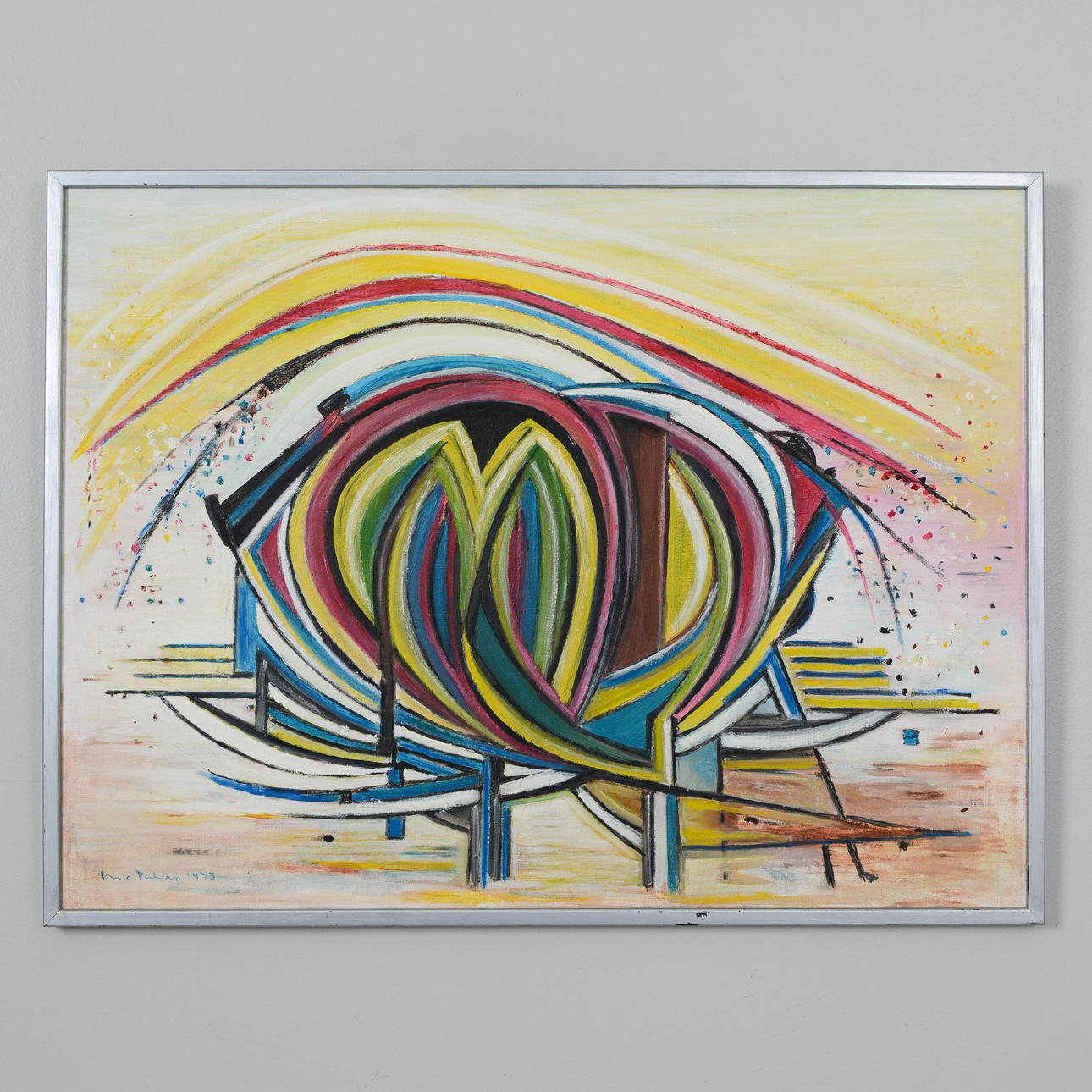
This work from 1973 belongs to Eric Pehap's mature period in Canada, when his painting had developed towards a freer and more abstract, symbolic visual language. The image is built around a dense central form where arches, points, and intertwined lines meet in a rhythmic structure. Around this core, bands of color spread out in red, yellow, blue, green, and black.
Despite the abstraction, there is a clear sense of movement. Forms shoot upwards, bend over one another, and seem to almost grow out of the picture surface, while the large arches above gather the composition. Pehap works with strong contours and clear color contrasts, which gives the painting both decorative strength and an almost architectural expression.
The work shows how far Pehap had moved from the more figurative landscapes and figure depictions that characterized his earlier years. At the same time, the same interest in rhythm, line, and movement remains, now transformed into an independent abstract visual language.
Eric Pehap, born in 1912 in Viljandi in present-day Estonia and died in 1981 in Toronto, was an Estonian painter and printmaker. He trained at art schools in both Tallinn and Tartu and completed his studies at the well-known Pallas Art School in 1939 with a focus on printmaking. During his studies, he also worked with painting, watercolor, drawing, and various graphic techniques.
Pehap began his professional career as an artist and drawing teacher in Estonia. However, the Second World War changed both his life and his artistry. He left Estonia in 1943, first for Finland and the following year for Sweden. During his years in Sweden, he worked as an illustrator, designer, and printmaker, depicting, among other things, refugee camps, boats, and landscapes from his new surroundings. He also participated in several exhibitions, including Estonian Art at Värmlands Museum in 1945 and Estonian and Latvian Art at Liljevalchs Konsthall in 1946.
In 1949, Pehap emigrated to Canada, where he would spend the rest of his life. He developed into a highly productive and technically experimental artist, working with both painting and printmaking. Cityscapes and figure compositions became recurring motifs, often with people in motion and with an increasingly free, more abstracted, and symbolic visual language. In printmaking, he also developed his own method, which he called the New Direct Method.
Pehap became an important figure within the Estonian artist circle in Toronto and was involved in forming the Estonian Artists' Association in Toronto (Eesti Kunstnike Koondis Torontos), where he also served as chairman for several years. During his time in Canada, he had a large number of solo exhibitions and participated in hundreds of group exhibitions internationally. His long journey from Viljandi via Finland and Sweden to Canada gave his artistry an unusually international character, while drawing and printmaking remained a clear foundation throughout his production.
Condition
No remarks.
Resale right
Theme
Do you have something similar to sell? Get your items valued free of charge!
Description
Frame dimensions: 62 x 83 cm.
This work from 1973 belongs to Eric Pehap's mature period in Canada, when his painting had developed towards a freer and more abstract, symbolic visual language. The image is built around a dense central form where arches, points, and intertwined lines meet in a rhythmic structure. Around this core, bands of color spread out in red, yellow, blue, green, and black.
Despite the abstraction, there is a clear sense of movement. Forms shoot upwards, bend over one another, and seem to almost grow out of the picture surface, while the large arches above gather the composition. Pehap works with strong contours and clear color contrasts, which gives the painting both decorative strength and an almost architectural expression.
The work shows how far Pehap had moved from the more figurative landscapes and figure depictions that characterized his earlier years. At the same time, the same interest in rhythm, line, and movement remains, now transformed into an independent abstract visual language.
Eric Pehap, born in 1912 in Viljandi in present-day Estonia and died in 1981 in Toronto, was an Estonian painter and printmaker. He trained at art schools in both Tallinn and Tartu and completed his studies at the well-known Pallas Art School in 1939 with a focus on printmaking. During his studies, he also worked with painting, watercolor, drawing, and various graphic techniques.
Pehap began his professional career as an artist and drawing teacher in Estonia. However, the Second World War changed both his life and his artistry. He left Estonia in 1943, first for Finland and the following year for Sweden. During his years in Sweden, he worked as an illustrator, designer, and printmaker, depicting, among other things, refugee camps, boats, and landscapes from his new surroundings. He also participated in several exhibitions, including Estonian Art at Värmlands Museum in 1945 and Estonian and Latvian Art at Liljevalchs Konsthall in 1946.
In 1949, Pehap emigrated to Canada, where he would spend the rest of his life. He developed into a highly productive and technically experimental artist, working with both painting and printmaking. Cityscapes and figure compositions became recurring motifs, often with people in motion and with an increasingly free, more abstracted, and symbolic visual language. In printmaking, he also developed his own method, which he called the New Direct Method.
Pehap became an important figure within the Estonian artist circle in Toronto and was involved in forming the Estonian Artists' Association in Toronto (Eesti Kunstnike Koondis Torontos), where he also served as chairman for several years. During his time in Canada, he had a large number of solo exhibitions and participated in hundreds of group exhibitions internationally. His long journey from Viljandi via Finland and Sweden to Canada gave his artistry an unusually international character, while drawing and printmaking remained a clear foundation throughout his production.
Condition
No remarks.
Resale right
Theme
Do you have something similar to sell? Get your items valued free of charge!
Payment options for this item
Payment cardsBank transferDelivery
: Provide your locationInfo temporarily unavailableLoading…Provide your location to see transport options and prices.
Oops! Something went wrong.
Please try again in a moment. If it still doesn't work, contact Auctionet support.
Details
- House
- Formstad Auktioner
- Address
Gårdsfogdevägen 16
168 67 Bromma
Sweden- Placement
- Tavelhylla 2