- Themes and hammer auctions
- /
- Good Art XXI
Good Art XXI
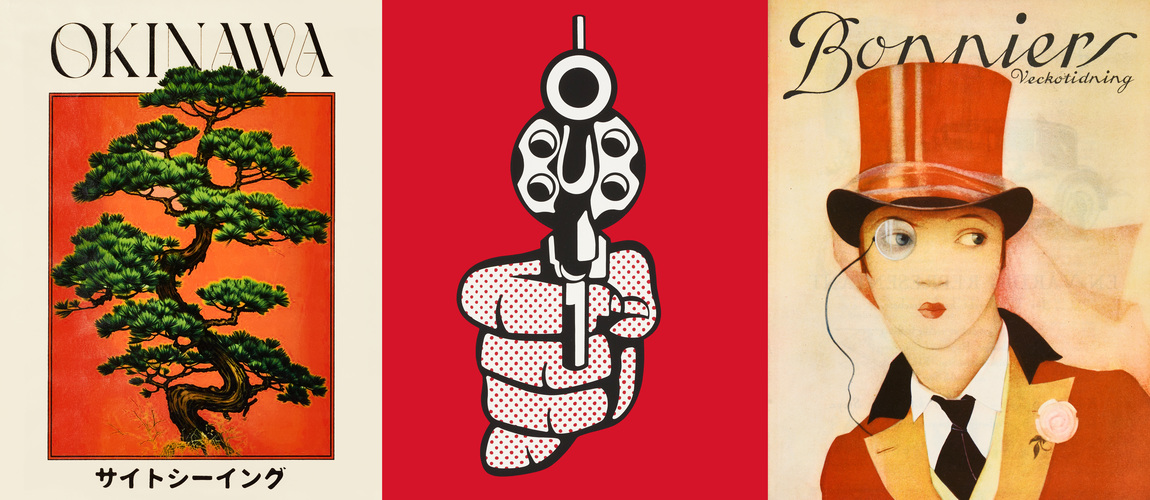
Crafoord Auktioner Stockholm presents the themed auction Good Art XXI, highlighting this month's selection of interesting artists and works. These deserve to be seen in context and will hopefully grace many walls.
We are now championing art with close to 250 works by a range of distinguished and exciting artists, including Christo & Jeanne-Claude, Tore Strindberg, Yrjö Edelmann, Madeleine Pyk, Man Ray, Åke Pallarp, Karel Appel, Pelle Åberg, Vera Frisén, Albert Contreras, Lars Pirak, Vasarely, Ragnar von Holten, Aly Ben Salem, Helge Lindén and Einar Jolin.
Highlights include Francis Brook Chadwick's portrait of his wife, Emma Löwstädt Chadwick; a museum-quality painting by Einar Nerman, dated 1909, depicting a model from Matisse's studio; and Björn Berg's illustrations of Emil i Lönneberga, among much more.
The auction also features high-quality prints by some of the most important artists of the 20th century. Among these are Miró, represented by a sheet from the suite Maravillas con Variaciones Acrósticas en el Jardín de Miró; John Whistler's Reading a Book; Chagall's Carmen and Die Zauberflöte; and Picasso's Colombe volant à l'arc-en-ciel and Le Vieux Roi. There is also Lichtenstein's Pistol, Man Ray's Telephone and two works by Hans Jörg Glattfelder.
Pelé is known above all as one of the greatest and most influential figures in football. We are proud to present Alfabild #635 in fine condition. This sought-after card is probably the first collector's card of the Brazilian footballer Pelé, made when he was just 17 years old at the 1958 World Cup in Sweden.
Leif-Erik Nygårds' (1939–2022) legendary photograph of Marilyn Monroe, taken at the Bel Air Hotel in Los Angeles in 1962, is another highlight of the auction.
The name God Konst has been used before. In 1941 HSB, the Swedish housing cooperative, opened the exhibition "GOD KONST I ALLA HEM" ("Good Art in Every Home"). Its aim was to promote good art in people's homes. The foreword to the catalogue noted that building good homes was not enough; art also had to have its place. The guiding principle was to offer good art to a wider public at affordable prices. To ensure that the art really was "good", a jury of well-known artists and art critics was appointed to review the works to be exhibited. As a result, it was possible, for example, to buy GAN's oil painting Berns 1918 for 5,000 kronor, the tempera Ratten for 350 kronor and Laboratorium for 500 kronor. Other artists in the "art for the people" project included Oskar Bergman, Einar Jolin, Arne Jones, Isaac Grünewald, Sixten Lundbohm, and Erik and Axel Olson. The exhibition's tenth anniversary was marked at Liljevalchs konsthall in Stockholm.
In the same year, 1941, Gunnar Hjorthén (1913–1997) opened Galleri God Konst on Vallgatan in Gothenburg. He came to be regarded as something of an institution in Gothenburg's art scene. The gallery later moved to several locations, including Drottninggatan, the Concert Hall and Södra vägen. Hjorthén devoted himself to promoting "young art", with artists such as Ivan Ivarson, Karin Parrow, Ragnar Sandberg and Inge Schiöler. It was largely thanks to Hjorthén and Galleri God Konst that Gothenburg Colourism became an established term. Like Svensk-Franska Konstgalleriet, Hjorthén looked to Paris early on, and through the gallery he brought the new painting to Sweden. In 1953, for example, the gallery exhibited Tsuguharu Foujita.
Welcome!