- Themes and hammer auctions
- /
- Mid Century Art
Mid Century Art
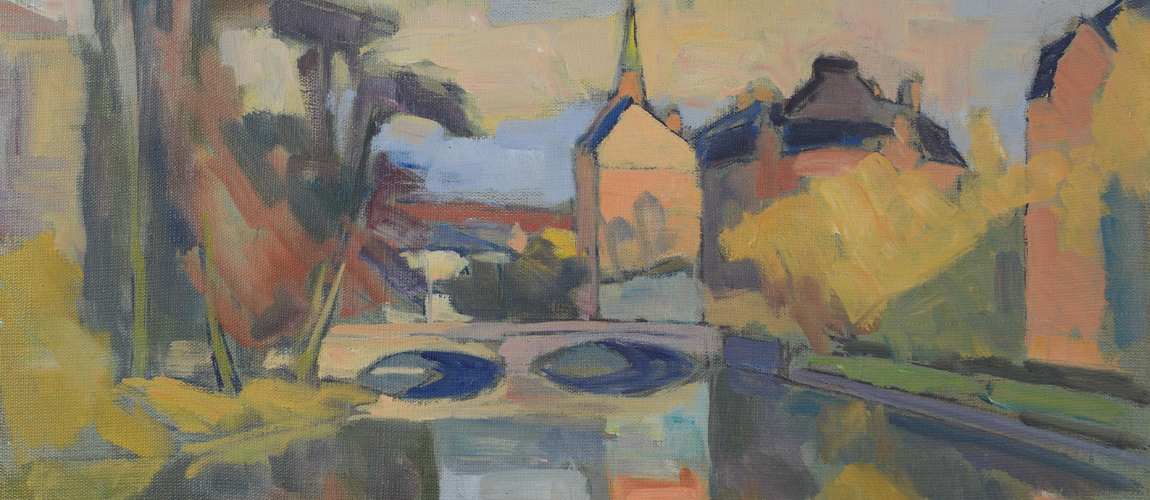
By the mid-20th century, modernism had become an established part of the Swedish and Nordic art scene. Artists moved with increasing freedom between the figurative and the abstract; landscapes, figures, cityscapes, and still lifes took on new forms of expression through simplified shapes, distinct fields of color, and a heightened interest in the rhythm and structure of the image.
At the same time, there remained a strong grounding in the visible world. The Nordic landscape recurs, alongside motifs drawn from travels across Europe and further afield. Traditional subjects persist, yet they are treated with greater personal vision and independence than before.
The auction reflects this diversity, featuring works that range from understated figurative painting to freer compositions where color and form all but take over. Together, they offer a glimpse of an era defined by immense artistic freedom, a time when tradition and modernism met and evolved side by side.
Three highlights
BERTIL ÖLLERSTAD, Winter in the City, oil on panel, dated 1943
A quiet cityscape in which the cold season and the enclosed architecture evoke a distinct atmosphere. The perspective is simplified and the color palette restrained, lending the subject an almost theatrical quality. Öllerstad’s painting is a fine example of how everyday urban settings could be imbued with both formal precision and a subtle psychological resonance.
JAN DAHLIN, Composition, oil on canvas, dated 1965
In Jan Dahlin’s composition, the figurative element has all but dissolved. An elongated blue form emerges against a lighter background, open to interpretation as either a figure or a pure structure of color. The image occupies the borderland between the human figure and abstraction that became significant in the post-war era. Few elements are employed, yet the contrast between the dense blue form and the open space lends the work a palpable presence.
NILS ÖBERG, "Still Life in Dark Blue" (Stilleben i mörkblått), oil on panel, dated 1940
The still life is one of the most recurring motifs of the 20th century, yet here the objects have yielded the stage to color as the protagonist. Deep blue and green tones construct a dense, almost self-contained pictorial world in which forms remain discernible while simultaneously merging with their surroundings. It is a fine example of how, during this period, a traditional motif could serve as a starting point for a considerably freer and more painterly mode of expression.
Active auctions
Items in Sweden
You currently see only items in Sweden. We have fixed shipping rates for all items.