We're afraid no items match your search.
- Themes and hammer auctions
- /
- Björn Erling Evensen
Björn Erling Evensen
FilterFilter and sort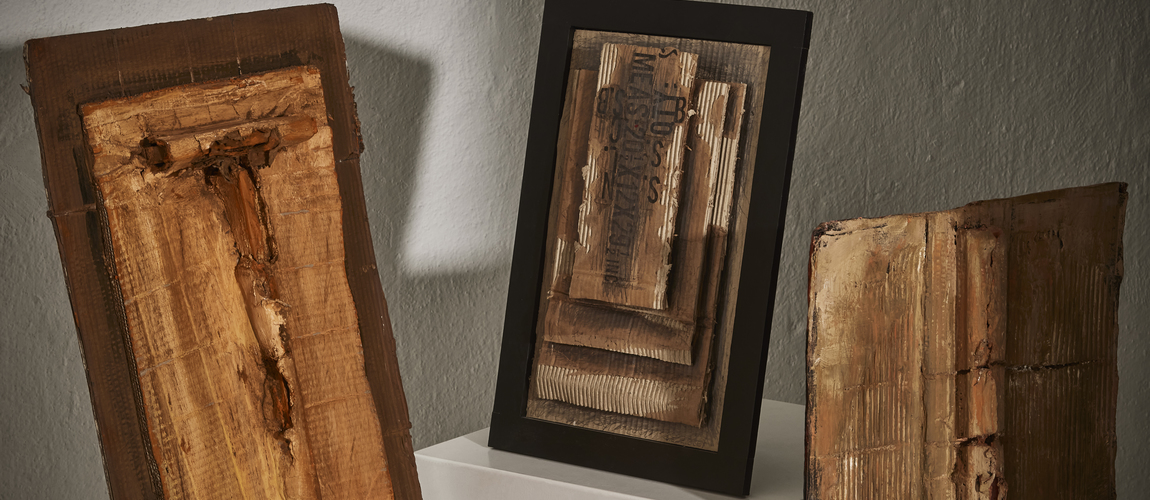
Björn Erling Evensen
Feb 26 2026 · Stockholms Auktionsverk Magasin 5
Stockholms Auktionsverk is proud to present a collection of works by Björn Erling Evensen (1924–2021). The sale comprises approximately twenty works in which the boundary between painting and sculpture becomes fluid. The works originate from the artist’s estate.
“The desire to reach the optimal expression leads to dramatic choices. Within this delicate process reside surprise, wonder, and uncertainty. The blessed possibilities of uncertainty for beauty, out there at the endpoint of the work — the one that does not exist, yet must be felt. That emotional process cannot be verbalised. To reconstruct it afterwards may be possible, but not to develop it into clarity.”
(From an interview in Om konst, 2005)*Björn Erling Evensen was a painter and sculptor with an internationally active practice. Born in Stockholm, he spent part of his childhood in Germany, where he witnessed the rise of Nazism. These experiences of political violence and the destructive aspects of human nature came to shape both his worldview and his artistic stance. Evensen himself expressed a fundamental scepticism towards humanity and described art as a space in which he could withdraw and explore existential questions without the need to formulate definitive answers.
He studied at art schools in Stockholm from 1947 and continued his education in London. Between 1947 and 1948 he undertook study trips to Paris, London, and Berlin, and in 1951–1952 he continued his studies at art academies in Rome and Palermo. He made his debut early in an international context, with his first exhibitions in London in the early 1960s, followed by numerous exhibitions in New York. In Sweden, he participated in, among other exhibitions, Young Draftsmen at the Nationalmuseum in 1951.
Evensen’s practice moved between painting, sculpture, and at times installation, where the boundaries between media are often blurred. Recurring motifs in his work include the gate and the cross. The gate became a lifelong theme, appearing in painting, sculpture, and drawing, often charged with meanings of transition, threshold, and the possibility of change. The cross functions less as a religious symbol than as a formal and existential point of intersection.
Materiality has always been central to Evensen’s work. He employed steel, wood, textile, paper, and other simple materials, kneading, bending, twisting, and working them until they underwent clear metamorphoses. In this process, soft materials could assume the character of hard, heavy substances such as iron or lead. Chance and unpredictability were essential components; Evensen regarded creation as a process in which the original idea is transformed, and where the work ultimately “chooses its own path.”
Evensen often emphasised that powerful art carries a secret, and that the artistic process cannot be fully articulated. He described uncertainty as a necessary and fertile element of the work — a condition in which surprise and doubt open up new possibilities rather than fixed conclusions.
Alongside his independent practice, Björn Erling Evensen completed numerous public commissions in Sweden and internationally. Among his most well-known works are Drottningen och hennes skepp (The Queen and Her Ship), previously installed at Stureplan in Stockholm and now at Jarlaplan; the seven-metre-high steel sculpture Spirit at Roosevelt Field in New York; and the sounding sculptures Gateways in Oslo and Perth, Australia. He also engaged in interdisciplinary collaborations with, among others, the composer Sven-Erik Bäck, the poet Östen Sjöstrand, and the dancers Donya Feuer and Ivo Cramer, integrating his sculptures with music and movement.
In the later part of his life, Evensen was based on the island of Gotland. He is regarded as one of Sweden’s most significant post-war sculptors, with an artistic practice consistently centred on the authority of form, the memory of materials, and the existential questions that resist definitive interpretation.
Message Andreas Siesing
Active auctions
Here are items from our archive that match your searchShow all items