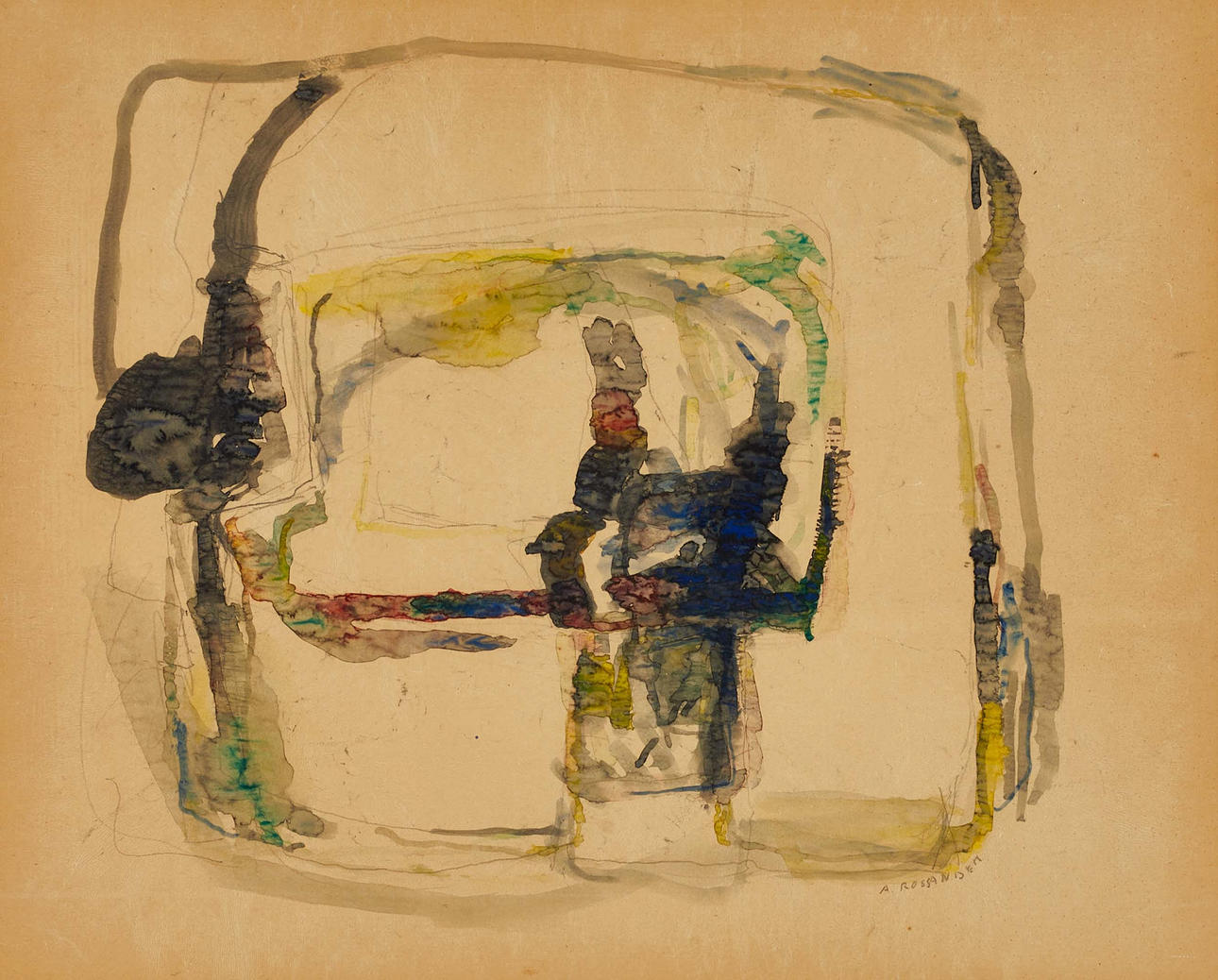
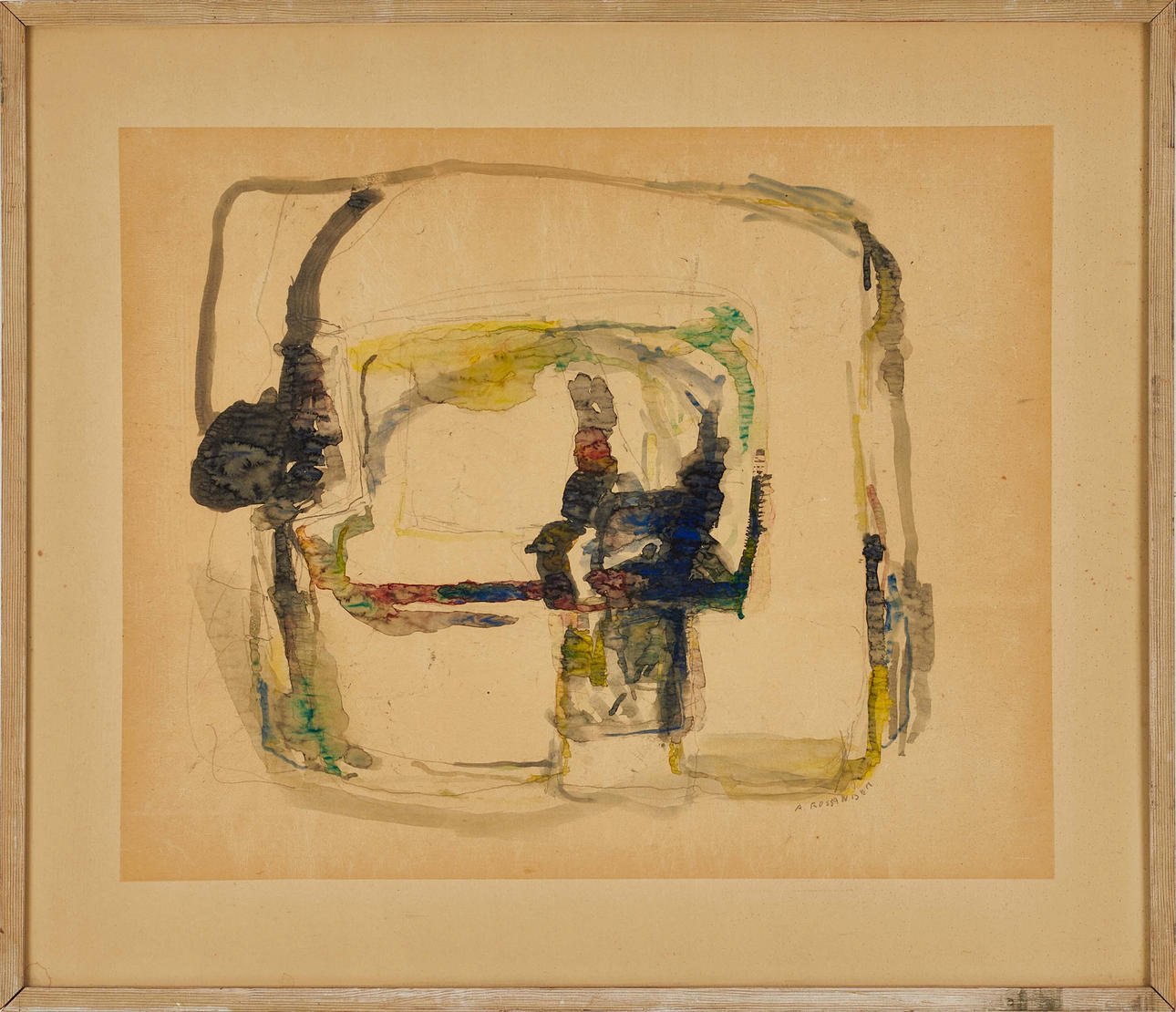
ARMAND ROSSANDER (1914–1976). Composition, signed, watercolour.

Images




Description
Armand Rossander (Duvbo 1914-1976 Stockholm)
Composition
Signed 'A ROSSANDER'
Watercolour, sheet dimensions
43x53.5 cm
Frame
58x67 cm
"In front of a painting by Armand Rossander, anyone who has seen even the slightest bit of modern art does not need to bend down and peek into the corner to be sure who the creator is. Rossander's signature is in every brushstroke, in every rendering of a natural form, in every perspective.
His way of painting has changed significantly since his debut, but the experience is so intensely personal that it characterizes every detail of his work.
I have never really loved that expression about the splinter in the eye, but when it comes to Rossander, the old notion has something to signify. Perhaps because there is mystery in his painting, a gift for humanizing natural forms, to tell about our world with a shift in the entire vision, a shift that is not so great that the impression becomes bizarre or fantastic, but sufficiently carried out so that something more than admiration for the painter's problem-solving begins to stir within us." (Karl Axel Arvidsson "Det unga måleriet", Stockholm 1952)
Armand Rossander was one of the artists who in the spring of 1947 exhibited at the now-famous group exhibition "Ung konst" (Young Art) at Galleri Färg och Form in Stockholm.
It was then that the critic Lars-Erik Åström coined the term "1947 års män" (The Men of 1947) for these exhibitors, even though there was also a woman among the exhibiting artists. In addition to Armand Rossander, Lennart Rodhe, Olle Bonniér, Pierre Olofsson, Karl Axel Pehrson, Lage Lindell, Uno Vallman, Olle Gill, Liss Eriksson, Knut Erik Lindberg and - the only woman - Randi Fisher participated in the exhibition.
Unlike the leading names Rodhe, Bonniér and Olofsson, Rossander did not adopt dogmatic concretism. Instead, he developed a freer style of painting, where figurative elements were still present in images with great space and organic overall effect. Alongside his easel painting, Armand Rossander also made a notable contribution as a monumental painter.
Represented: Moderna Museet (several works), Gothenburg Museum of Art, Archive of Decorative Art in Lund, the museums in Kalmar, Växjö and Jönköping, as well as the National Gallery in Oslo.
Condition
Not examined out of frame.
Resale right
Theme
Bidding
Item is located in Stockholm, Sweden
Description
Armand Rossander (Duvbo 1914-1976 Stockholm)
Composition
Signed 'A ROSSANDER'
Watercolour, sheet dimensions
43x53.5 cm
Frame
58x67 cm
"In front of a painting by Armand Rossander, anyone who has seen even the slightest bit of modern art does not need to bend down and peek into the corner to be sure who the creator is. Rossander's signature is in every brushstroke, in every rendering of a natural form, in every perspective.
His way of painting has changed significantly since his debut, but the experience is so intensely personal that it characterizes every detail of his work.
I have never really loved that expression about the splinter in the eye, but when it comes to Rossander, the old notion has something to signify. Perhaps because there is mystery in his painting, a gift for humanizing natural forms, to tell about our world with a shift in the entire vision, a shift that is not so great that the impression becomes bizarre or fantastic, but sufficiently carried out so that something more than admiration for the painter's problem-solving begins to stir within us." (Karl Axel Arvidsson "Det unga måleriet", Stockholm 1952)
Armand Rossander was one of the artists who in the spring of 1947 exhibited at the now-famous group exhibition "Ung konst" (Young Art) at Galleri Färg och Form in Stockholm.
It was then that the critic Lars-Erik Åström coined the term "1947 års män" (The Men of 1947) for these exhibitors, even though there was also a woman among the exhibiting artists. In addition to Armand Rossander, Lennart Rodhe, Olle Bonniér, Pierre Olofsson, Karl Axel Pehrson, Lage Lindell, Uno Vallman, Olle Gill, Liss Eriksson, Knut Erik Lindberg and - the only woman - Randi Fisher participated in the exhibition.
Unlike the leading names Rodhe, Bonniér and Olofsson, Rossander did not adopt dogmatic concretism. Instead, he developed a freer style of painting, where figurative elements were still present in images with great space and organic overall effect. Alongside his easel painting, Armand Rossander also made a notable contribution as a monumental painter.
Represented: Moderna Museet (several works), Gothenburg Museum of Art, Archive of Decorative Art in Lund, the museums in Kalmar, Växjö and Jönköping, as well as the National Gallery in Oslo.
Condition
Not examined out of frame.
Resale right
Theme
Payment options for this item
Payment cardsBank transferDelivery
: Provide your locationInfo temporarily unavailableLoading…Provide your location to see transport options and prices.
Oops! Something went wrong.
Please try again in a moment. If it still doesn't work, contact Auctionet support.
Details
- Address
Galoppvägen 3
183 64 Täby
Sweden- Placement
- Vagn 11 - Ställage 4 (Vasakonst)