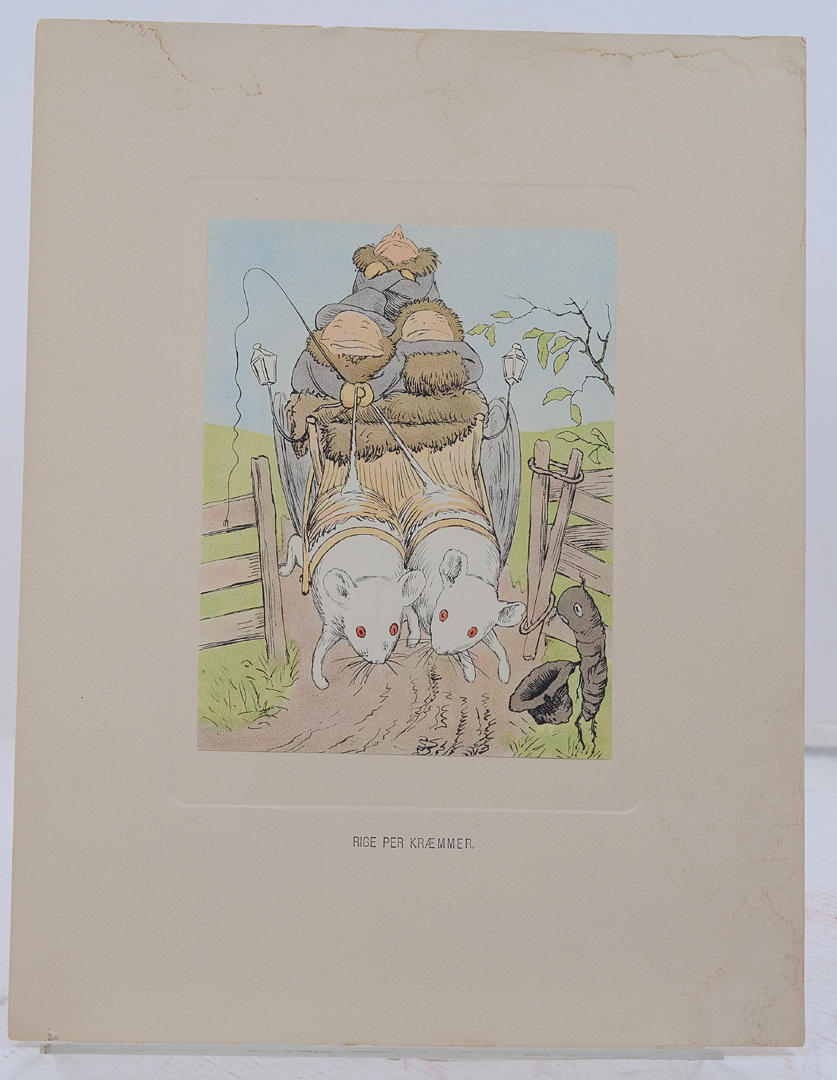
THEODOR KITTELSEN. Rige Per Kraemmer.
This auction is closed, but maybe you like the following items?

Images
Description
mounted lithographic color print from the folder: "Do animals have soul?" without year (1894) Ernst Bojesen's Kunstforlag, Kjöbenhavn. . 145 x 185 mm (sheet size 243x317mm) This copy is from the planchwerk that was published in 1894. the year after the book edition.
Do animals have souls? is the title of a series of 22 pen and watercolor drawings that Theodor Kittelsen (1857-1914) wrote and drew in the fall of 1893. It was an order from the then leading publisher of Christmas booklets and humor magazines in Denmark, Ernst Bojesen, and the first edition was published as a board book the following year. In retrospect, Har Dyrene Sjæl? been lifted up in the literature about Kittelsen as one of his main works in his humorous and satirical cartoon production. Nevertheless, Kittelsen's humorous and satirical art is seen as a secondary parallel to his other national, lyrical art and illustration works, and they are also less well known. This thesis focuses on this part of Kittelsen's art. In Kittelsen's humorous production, he often combines the interpretation of animal fables with a satirical and playful look at the present. A main focus of the thesis is the elucidation of the extent to which the humorous elements of caricature and pictorial satire are integrated in the part of Kittelsen's humorous production where he uses animals. It is also discussed to what extent his macabre personifications of nature are an expression of a retreat from civilization. The humorous animal productions in Har Dyrene Sjæl? analyzed with this in mind. Central to the thesis is a review of the creation and an analysis of the drawings in Har Dyrene Sjæl? . Kittelsen is able to caricature using exaggeration, unmasking and grotesque figures as tools. Through text and images, he gives small animals a satirical and often self-deprecating dimension that falls under a carnivalistic tradition of satire and caricature. A convention from the animal types and characteristics of the fable tradition is often used here. In Do Animals Have Souls? you are the crawling insects; frogs, lizards, mice, small birds, snails, toads, flies and grasshoppers. Traditionally, people through the centuries, in fables, fairy tales and socially critical caricatures, have given such expensive negative character traits, a negative symbolism. We also see this with Kittelsen in his way of using grotesque and ugly figures to create a comic effect. Insects and other small critters are also used in the contemporary Art Nouveau style. Typical here is the use of unconventional elements taken from nature, and the focus on what at the time was considered naughty. This is also discussed in the thesis. By focusing on Kittelsen's humor production, especially Har Dyrene Sjæl? where he uses anthropomorphic representations, one can gain a better understanding of this lesser-known part of his production. The task is also a contribution to Norwegian visual satire and caricature history (Tina C Jensen).
Condition
Slightly damp stained in the upper part.
Resale right
Artist/designer
Do you have something similar to sell? Get your items valued free of charge!
Description
mounted lithographic color print from the folder: "Do animals have soul?" without year (1894) Ernst Bojesen's Kunstforlag, Kjöbenhavn. . 145 x 185 mm (sheet size 243x317mm) This copy is from the planchwerk that was published in 1894. the year after the book edition.
Do animals have souls? is the title of a series of 22 pen and watercolor drawings that Theodor Kittelsen (1857-1914) wrote and drew in the fall of 1893. It was an order from the then leading publisher of Christmas booklets and humor magazines in Denmark, Ernst Bojesen, and the first edition was published as a board book the following year. In retrospect, Har Dyrene Sjæl? been lifted up in the literature about Kittelsen as one of his main works in his humorous and satirical cartoon production. Nevertheless, Kittelsen's humorous and satirical art is seen as a secondary parallel to his other national, lyrical art and illustration works, and they are also less well known. This thesis focuses on this part of Kittelsen's art. In Kittelsen's humorous production, he often combines the interpretation of animal fables with a satirical and playful look at the present. A main focus of the thesis is the elucidation of the extent to which the humorous elements of caricature and pictorial satire are integrated in the part of Kittelsen's humorous production where he uses animals. It is also discussed to what extent his macabre personifications of nature are an expression of a retreat from civilization. The humorous animal productions in Har Dyrene Sjæl? analyzed with this in mind. Central to the thesis is a review of the creation and an analysis of the drawings in Har Dyrene Sjæl? . Kittelsen is able to caricature using exaggeration, unmasking and grotesque figures as tools. Through text and images, he gives small animals a satirical and often self-deprecating dimension that falls under a carnivalistic tradition of satire and caricature. A convention from the animal types and characteristics of the fable tradition is often used here. In Do Animals Have Souls? you are the crawling insects; frogs, lizards, mice, small birds, snails, toads, flies and grasshoppers. Traditionally, people through the centuries, in fables, fairy tales and socially critical caricatures, have given such expensive negative character traits, a negative symbolism. We also see this with Kittelsen in his way of using grotesque and ugly figures to create a comic effect. Insects and other small critters are also used in the contemporary Art Nouveau style. Typical here is the use of unconventional elements taken from nature, and the focus on what at the time was considered naughty. This is also discussed in the thesis. By focusing on Kittelsen's humor production, especially Har Dyrene Sjæl? where he uses anthropomorphic representations, one can gain a better understanding of this lesser-known part of his production. The task is also a contribution to Norwegian visual satire and caricature history (Tina C Jensen).
Condition
Slightly damp stained in the upper part.
Resale right
Artist/designer
Do you have something similar to sell? Get your items valued free of charge!