Lo sentimos, no tenemos ningún lote que coincida con lo que estás buscando.
- Temas y subastas en sala
- /
- Röllakan & Rya Rugs
Röllakan & Rya Rugs
FiltrosFiltra y ordena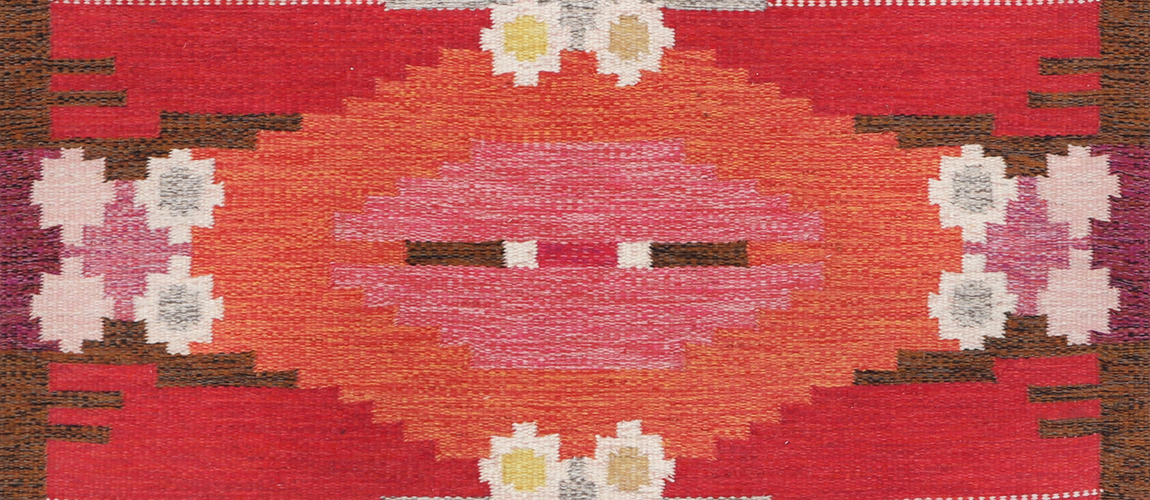
Röllakan & Rya Rugs
28 ene 2026 · Formstad Auktioner
Here, röllakan and rya rugs meet in a thematic selection that reflects the development of Swedish textile art from regionally rooted craft traditions to a self-aware visual language shaped by the ideas and expressions of modernism. The rugs testify to a tradition in which technique and material are as meaningful as pattern and colour, and where the weave functions both as a utilitarian object and as a defining spatial element.
The flat-woven technique of röllakan gives the surface a distinct structure, where the weft forms the pattern with precision and clarity. Colour fields are often clearly delineated and arranged in borders and central panels, creating rhythm and balance across the entire surface. The rya works in the opposite direction through its knotted pile, where volume, light, and materiality are given greater scope. Here, form is built through density and fibre, resulting in a softer, more corporeal expression. Together, these techniques demonstrate the breadth of Swedish and Nordic rug art, ranging from graphic restraint to tactile presence.
Among the most prominent works in the auction is Judith Johansson, whose large röllakan rugs are distinguished by a consistently modern composition and a confident command of colour and proportion. Her visual language unites a folkloric foundation with a contemporary calm that lends the rugs a monumental presence. Ingegerd Silow is richly represented and demonstrates her versatility. Several works feature her characteristic use of circular motifs, carefully balanced borders, and a palette that moves between muted sand tones, cool blues, and soft grey-green shades. A larger-format piece in light pink and warm yellow stands out for its generous scale and almost architectural structure. The long, narrow röllakan with dense small-scale decoration and a softly subdued colour scheme is notable for its patina. Wear and shifts in colour contribute to the whole, creating a lived-in expression in which time itself has become part of the composition.
Taken as a whole, the selection offers a cohesive picture of Nordic textile art, where tradition, formal sensitivity, and material knowledge interact. The rugs are created to be used and experienced over time; they anchor a space through colour and texture and function just as convincingly in historic interiors as in contemporary settings. This is textile art for the slow gaze of everyday life, where the work of the hand and the intention of the designer remain present.
Subastas en curso
Estos son los lotes existentes nuestro archivo que coinciden con tu búsqueda.Mostrar todos los lotes