Lo sentimos, no tenemos ningún lote que coincida con lo que estás buscando.
- Temas y subastas en sala
- /
- Sven-Arne ”Höken” Hökenström
Sven-Arne ”Höken” Hökenström
FiltrosFiltra y ordena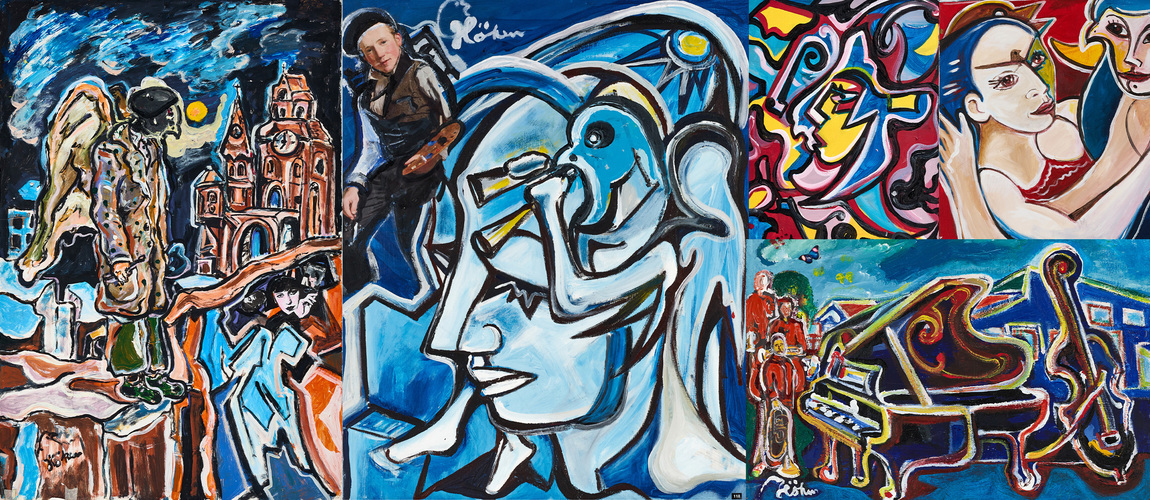
Sven-Arne ”Höken” Hökenström
21 sep 2025 · Crafoord Auktioner Stockholm
Sven-Arne "Höken" Hökenström – A Retrospective
Crafoord Auktioner Stockholm is proud to present a themed auction devoted to the artist Sven-Arne "Höken" Hökenström (1947–2025), comprising 200 works.
A social misfit with an open disdain for snobbery
Farsta, a winter evening in 2025. I am out walking the dog when I happen to run into an old friend and one of his companions. We greet each other and speak about the news we have just heard – that Höken has passed away. My friend’s companion recalls seeing him once, as a young kid hanging around in town, and shouting: “Isn’t that Höken?” The reply came instantly: “Damn right it’s Höken!”
Höken was a cultural personality, a familiar figure in several different subcultural circles, and even appeared as a character in Gunnar Lundkvist’s debut comic book Klas Katt i Hell City (1979). What other artist, I wonder, could have received that question from a group of kids – and delivered such an immediate and definitive reply? And we all knew him simply as Höken – the Hawk – in the definite singular. For him, the name itself was also a symbol of freedom, as he said in a documentary from the late 1970s.
It may seem improbable, but Höken managed to turn an archetypal, almost banal bird-of-prey name into his pseudonym – and we accepted it as his true name. Perhaps it was because both as an artist and a cultural figure he appeared larger than life. At least that is how I saw him when I first got to know him in the late 1980s. By then he was already legendary as a pioneer of brigade painting, and newly appointed principal of Kungsholmen’s graffiti school. I myself was a teenage graffiti artist, allowed together with a few friends to paint in one of the rooms. Höken’s booming voice, steeped in a thick southern Stockholm dialect, echoed through the halls and directed the activity. I remember it as if it were yesterday, and I can hear it again now in a news clip on SVT after his death: “Get started drawing now – the paints have arrived!”
Another reason why the pseudonym Höken never seemed pompous or banal was that it could also be read as a nickname. His real name was Sven-Arne Hökenström, and he often signed his works with it.
Sven-Arne Hökenström, a.k.a. Höken, was born in 1947 and grew up in Aspudden, then a notorious suburb of Stockholm. In Rainer Hartleb’s first documentary film Jag bor på Hägerstensvägen (1970), the neighborhood is portrayed as a severely neglected area, a place where only “people with low demands” moved. In a later interview from 2011, Hartleb was even blunter, describing Aspudden as a place “where people with social problems were dumped [...] Hägerstensvägen, it was like… one described it as a sewage ditch…”
The Aspudden of Höken’s youth was what we would today call a marginalized neighborhood. I believe this is where he absorbed an underdog perspective and a commitment to those who did not fit into society. It is worth noting that he was active as a self-taught educator, and that besides being principal of several graffiti schools he also worked as a boxing coach – and as a painting instructor within associations such as Kriminellas Revansch i Samhället (Criminals’ Revenge in Society) and Nobba Brass och Nubbe (Say No to Booze and Weed). The cultural figure and underground celebrity he became rested as much on this role as educator as on his role as artist. In both roles he was something of an outlier: socially active and anchored in many different communities, yet always an outsider to cultural cliques and artistic circles.
I recall visiting an exhibition of Höken’s in the early 1990s at a gallery on Kungsholmen. There was no gallerist present, only the artist himself. I had just begun studying art history, and I remember a wonderful conversation about his art, his artistic influences, and some of the graffiti artists we both knew and admired. After a while I realized he had most likely rented the space himself and arranged his own solo exhibition. Looking back now, it is clear he never had any long-term collaboration with a gallerist or curator, preferring instead to sell his works directly, without intermediaries. It is hardly the easiest or most successful career path in today’s professionalized art world – but probably the only one he felt comfortable with. At least, the only one possible for him. Already in relation to the brigade painting with which he was early associated, he appears as something of an outsider. In an exhibition catalogue from Kulturhuset, art critic Leif Nylén describes brigade painting as part of the alternative movements of the 1970s and “the urban struggle that culminated in the occupation and eventually the storming of Mullvaden in 1978.”
In Bengt Olvång’s art historical survey Våga se! Svensk konst 1945–1980 from 1983, the description is similar: brigade painting is “a continuation and further development of the ideas about street art that were born during the turbulent year of 1968.” Among the collectives and groups that Olvång describes, Höken is one of the few individual artistic practices, and the author suggests that Höken “tried to give concrete a human face by spraying portraits and comic strip figures on it. The red-nosed clown with his seagull at the Mariatorget subway station is the most poetic of those I have seen.” Incidentally, it was at Mariatorget that the “urban struggle” over the Mullvaden block took place. Höken appears both within and at the same time slightly outside the structure and purpose of brigade painting.
The interest in form and style, in the subway as a place, and the use of an individual pseudonym were elements Höken shared with the graffiti painting with which he was also associated, not least after his role as principal of the graffiti school. Leif Nylén also notes that there are certain similarities between brigade painting and graffiti painting, for example in the mostly illegal painting and the organizing of groups—into crews and brigades respectively—but he also points out that the differences are great: “if the brigades made content into style, then style itself is the content of graffiti painting.”
Even in relation to graffiti, Höken appears as an outsider. In Staffan Jacobson’s dissertation The Spray-Painted Image: Graffiti Painting as Image Form, Art Movement and Learning Process, he is described as one of several more traditionally trained artists (among them Jean-Michel Basquiat and Harald Naegeli) who “create images that make partial use of the technical and formalistic code but with content that is more unaffected by graffiti iconography [...] they play ‘a different language game,’ as Wittgenstein might have said; at least they play on another field.”
Höken’s visual language and aesthetic ideals, with a clear influence from early modernist movements such as Surrealism, Impressionism, and Expressionism, differ from graffiti’s letter-centered and, broadly speaking, more postmodern painting. To judge Höken’s images in relation to graffiti painting, following Jacobson’s reasoning, is to the advantage of neither Höken nor graffiti.
That Höken had a different educational path than most graffiti painters is probably true, but it was not really a matter of traditional art training. Aside from a couple of shorter preparatory art schools, his longest education was as a scenic painter at the Royal Opera.
More here on Höken’s own artistry
A narrative, storytelling painting with, as Olvång already pointed out, poetic elements. Höken’s distaste for cliques and snobbery should not be interpreted as a sign of lacking self-confidence or self-appreciation. He possessed both self-awareness and integrity, evident not least in the many newspaper articles about him from the early 1970s onwards. It is also visible in his collaboration with the musician and ballad singer Bernt Staf in the early 1970s. For the album Vingslag (1972), he created a Surrealist-influenced painting in which the artist himself appears in the lower right corner, painting a triptych that also seems to form a window onto the world. On the released record he is clearly acknowledged as one of the creators (“Painting: Sven Arne Hökenström”), alongside Staf himself (“Lyrics & Music”), as well as technician Michael B. Tretow and producer Anders Burman. Bernt Staf also described the record as having been created in close collaboration with Höken, who likely also inspired its title.
From the outside, and in hindsight, it seems that Höken always went his own way, entering many contexts and groups without ever fully becoming a part of them. He had long-lasting friendships and close collaborations with graffiti artists such as Brain and Christian Lajozz. Certainly we can call him a graffiti painter, as he is labeled on Wikipedia, or as a brigade painter. Neither designation is entirely wrong—but neither is it wholly accurate.
Art historically, I would rather place him in a tradition of outsider artists such as Lim-Johan, Primus Mortimer Pettersson, and Victoria Nygren. Or perhaps even more fittingly the naïvist Olle Olsson Hagalund. Just like Höken, Olsson Hagalund had both an interest in and a background in scenography and scenic painting. Both also share a painting style that combines the poetic with the narrative, and not least a solidarity with those who came into conflict with the rationality and progress of modern society.
But Sven-Arne Hökenström, alias Höken, ultimately appears more as an outsider among outsiders, and his painting is probably best judged in relation to himself: a socially gifted eccentric with both a poetic and narrative painting style, and an evident aversion to snobbery and cultural pretentiousness. “Hell yes, it’s Höken!”
Jacob Kimvall,
Doctor of Art History, Senior Lecturer at Stockholm University and Konstfack
Subastas en curso
Estos son los lotes existentes nuestro archivo que coinciden con tu búsqueda.Mostrar todos los lotes