Karl Johan “Kalle” Andersson, often referred to simply as “Xylografen” (The Xylographer), was a renowned Swedish artist celebrated for his mastery of wood engraving and his unique place in Swedish art history. Born in Brännkyrka parish, Stockholm County, Andersson’s early life was marked by a strong inclination toward drawing, which led him to pursue formal training at Slöjdskolan (now Konstfack) and later at the Royal Academy of Fine Arts’ preparatory school, Konstakademins principskola, in Stockholm.
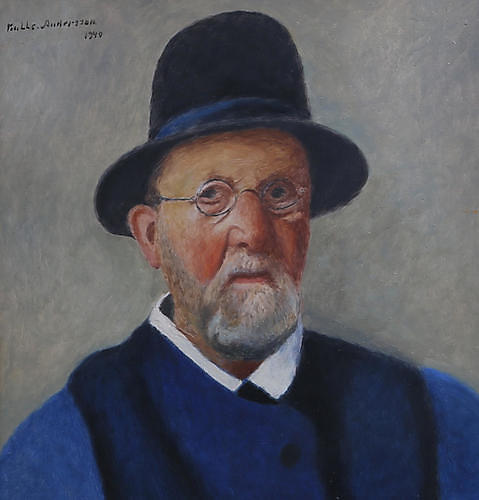
Self-portrait, oil on Board.
Andersson’s career as a xylographer began in earnest when he was employed by Ny Illustrerad Tidning, a prominent illustrated magazine of the time. His exceptional talent was recognised early, and in 1883 he was awarded a scholarship by the Board of Trade (Kommerskollegium) that enabled him to undertake a study trip to Paris. Despite his success, the rise of photochemical reproduction techniques in the late 19th and early 20th centuries gradually made the traditional craft of xylography obsolete. As a result, Andersson’s profession became increasingly redundant, and he eventually moved to Grisslehamn in 1892, seeking a healthier environment after contracting tuberculosis.
In Grisslehamn, he became a close friend of the artist and writer Albert Engström, who would later immortalise Andersson in his stories and drawings.
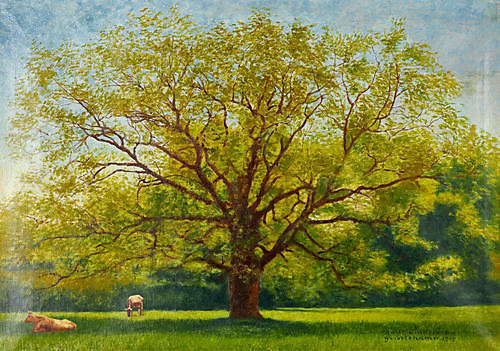
Eken - Grisslehamn, signed, oil on canvas.
Artistic Range and Painting
Alongside his wood engraving, Andersson produced around 1,500 oil paintings, primarily landscapes, nude studies, and local scenes from Roslagen. His paintings are characterised by meticulous detail and strong compositional balance, reflecting the same precision as his engravings.
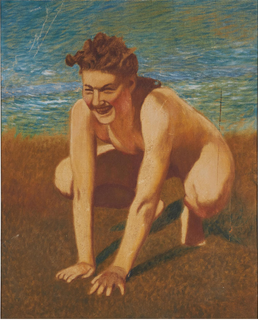
Woman by the beach, oil on panel.
Representation and Legacy
Andersson’s works are represented in the Nationalmuseum in Stockholm, confirming his importance in Swedish graphic arts. His career exemplifies the transition from handcrafted reproduction to modern printing, and his legacy endures both through his own art and Engström’s portrayals that celebrated a vanished craft.