Wassily Kandinsky was a pioneering Russian painter and art theorist, widely regarded as one of the founders of abstract art. His work marked a significant departure from traditional forms, focusing instead on the expressive power of colour and form without direct reference to the physical world. Kandinsky's theories on colours and shapes influenced the development of modern abstract art.

Tapestry/Artist Rug, Cotton, Silk. Clubbed for 325 GBP at Stockholms Auktionsverk Köln.
Kandinsky believed that colours and shapes could be used to express the artist's inner life, much like the notes and rhythms of music. This belief led him to create some of the first purely abstract works in modern art, where colour and form carried the meaning itself. His groundbreaking painting, 'Composition VII' (1913), is often cited as one of the most complex works of abstract art, characterised by its vibrant colour palette and dynamic movement.
Theoretical Contributions to Art
In addition to his painting, Kandinsky was an important art theorist. His book 'Concerning the Spiritual in Art' (1911) introduced concepts about the psychological effects of colour and the idea that art could visually express musical compositions. Kandinsky's ideas helped shape the Bauhaus school of art and design, where he taught as a master until the Nazis closed it in 1933.
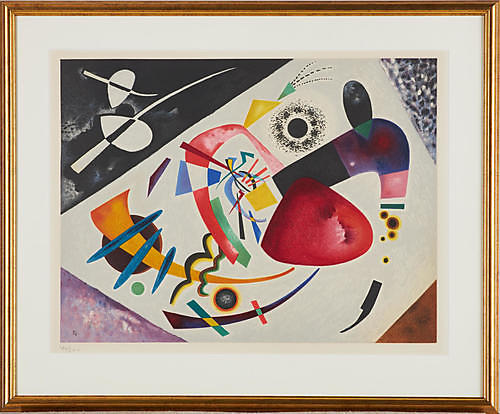
Roter Fleck II
Wassily Kandinsky passed away in 1944.