Yves Klein (1928–1962) was a French artist and one of the most influential figures on the postwar European art scene. He was born on April 28, 1928, in Nice, France, and died on June 6, 1962, in Paris, at only 34 years of age.
Biography and Artistic Background
Klein came from an artistic family. Both his father, Fred Klein, and his mother, Marie Raymond, were painters. He received no formal art education but grew up surrounded by artistic environments, which deeply shaped his creative path. Even before fully committing to art, he studied judo. Between 1952 and 1954, he lived in Japan, where he became the first European to achieve the fourth dan (yodan) rank at the Kodokan Institute.
This experience contributed to his lifelong interest in ritual, the body, and presence—central themes that would later define his art.
Artistic Work and Key Pieces
Klein’s work is characterized by a strong focus on color, space, and immaterial expression. He is particularly associated with the ultramarine blue pigment that he developed together with the paint dealer Édouard Adam. This hue became known as International Klein Blue (IKB).
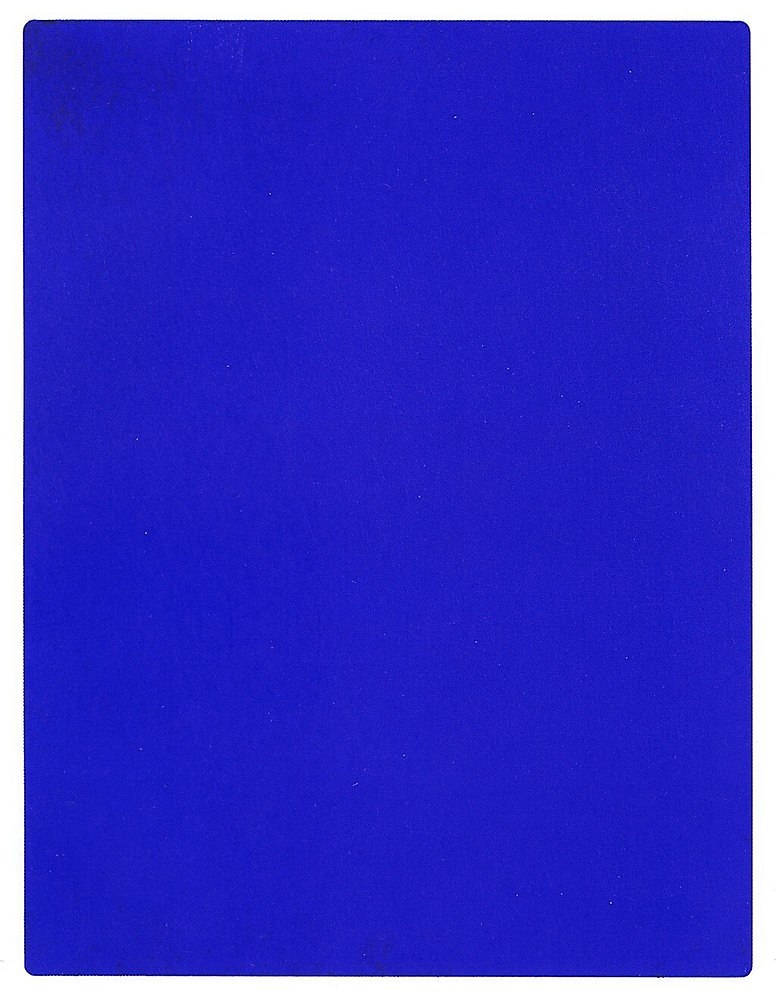
Klein Blue (IKB)
In his early exhibitions, Klein realized that viewers perceived his series of monochrome paintings in different colors as decorative mosaics. As a result, he decided to abandon the use of multiple colors and instead concentrate entirely on one color field (IKB) as a total experience.
One of his most famous works was the exhibition Le Vide (The Void, 1958) at Galerie Iris Clert in Paris, where he deliberately presented an almost empty gallery. He painted the walls white, removed all objects, and staged an entrance with a blue curtain and blue balloons to emphasize the experience of nothingness.
Klein also experimented with performance and the human body as an artistic instrument, most famously in his Anthropometries series, where nude models were covered in blue paint and used as “living brushes” to imprint their bodies onto canvas.
He also explored conceptual works such as the Zones of Immaterial Pictorial Sensibility, in which he sold empty space for gold, sometimes burning the certificate of sale and throwing the gold into the river as part of the artistic ritual.
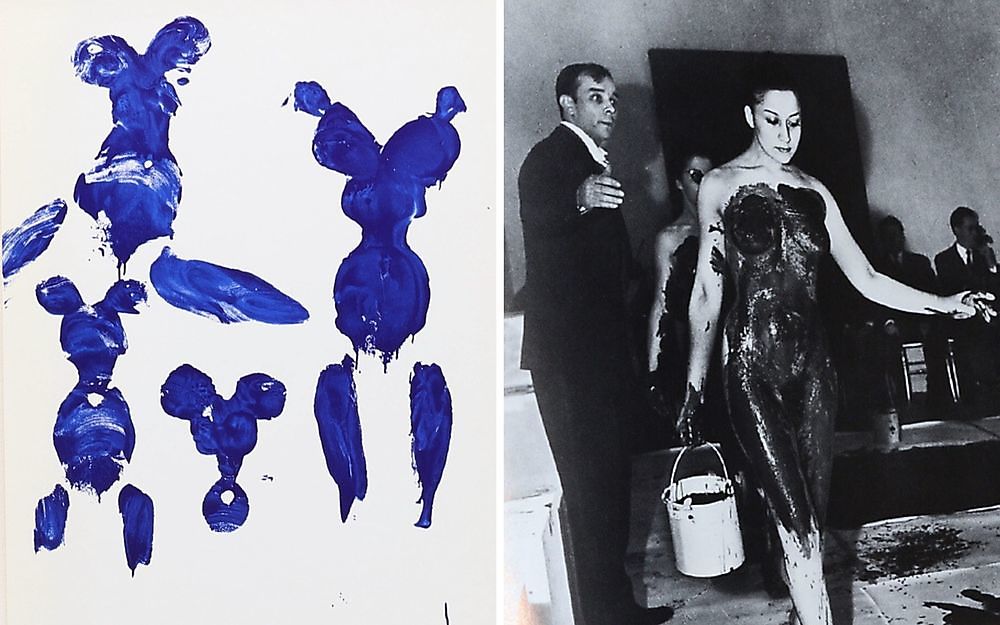
Images from Pierre Restanys book about Yves Klein
Movement and Influence
Klein played a key role in founding the art movement Nouveau Réalisme (New Realism) in 1960, together with figures such as Pierre Restany. The group sought to question traditional boundaries in art and challenge how reality is perceived through artistic representation. Klein is regarded as a pioneer of performance art, monochrome painting, and as a forerunner of both minimalism and pop art.
Market and Legacy
Despite his short life, Klein left a profound legacy. His works have achieved record-breaking auction results. His artistic position is firmly established through both his historical importance and continued strong demand in the art market.
Importance for Collectors and Institutions
Klein represents the transition from traditional painting to concept-based art. In his work, color is not merely pigment but an object in itself, and materiality transforms into space, body, and immateriality. His oeuvre holds relevance both within art history and as a form of investment. The strong auction record supports the latter, while the conceptual dimensions of his work continue to provide depth and inspiration for curators and scholars alike.