Truda Carter, born Gertrude Ethel Sharp in 1890, was the youngest in a family of seven children, growing up under the influential eye of her father, renowned entomologist David Sharp. Fostered in an environment where science and observation flourished, Carter soon gravitated toward the arts. She studied applied arts and embroidery design at the Royal College of Art in London, where she met her future husband John Adams, a fellow ceramicist. Their shared passion took them to Durban, South Africa, after their marriage in 1915, where they both taught at the Durban Technical College and established the pottery section. This period proved formative, as Carter deepened her hands-on experience in ceramics.
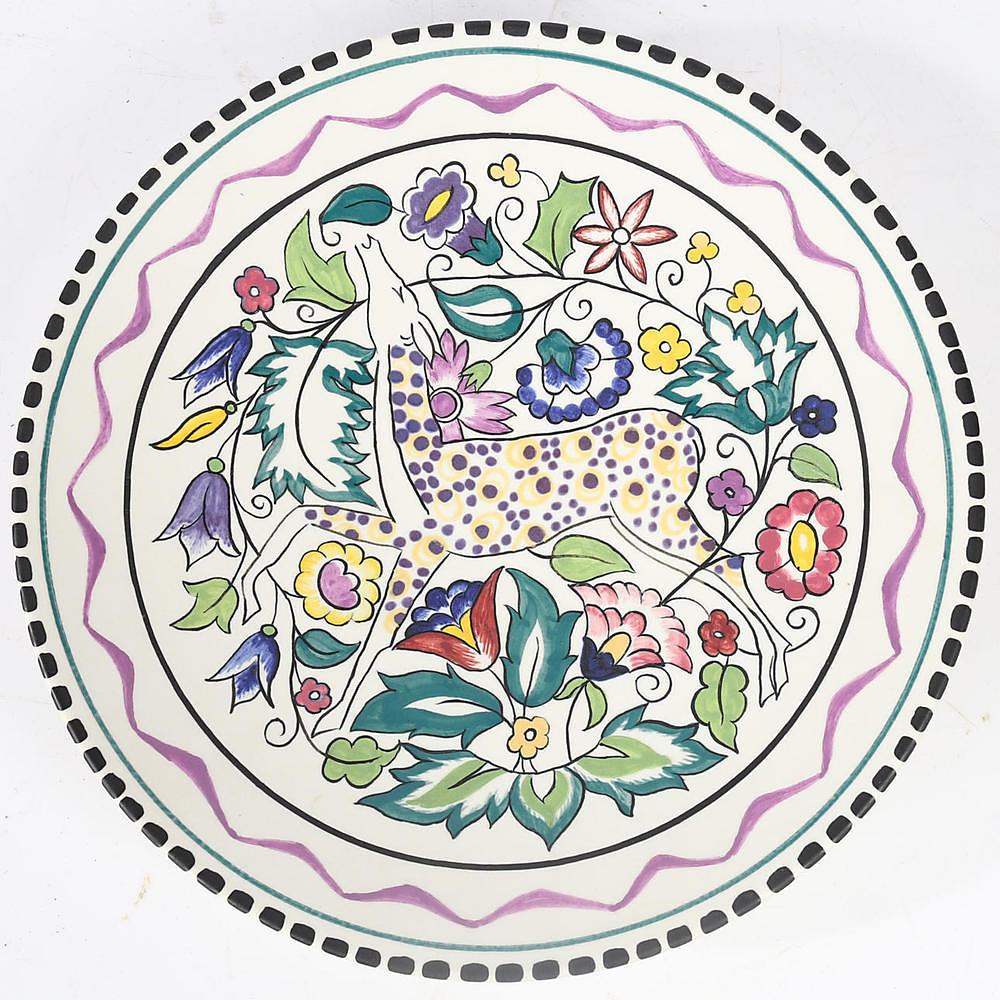
"Persian Deer", plate, clubbed for 25 GBP at Bishop & Miller.
Pattern and Innovation: Defining Poole Pottery’s Art Deco Brilliance
After World War I, Carter returned to Britain and became a cornerstone at Carter, Stabler, and Adams Ltd in Poole, Dorset, in 1921. At Poole Pottery, she flourished as a visionary designer, initially evolving geometric patterns from her predecessor before imprinting her own signature style. Her designs synthesized the bold abstraction of European modernism and cubism with the sensuousness of post-impressionism and English decorative tradition. Drawing on her background in embroidery, Carter’s patterns featured polychrome triangles, circles, and vibrant floral motifs, merging energetic abstraction with organic forms. Her forward-thinking aesthetic was both accessible and avant-garde, dramatically elevating Poole Pottery’s identity and ensuring its place at the forefront of the Art Deco movement. Exhibited widely, most notably at the Royal Academy and International Exhibition in Paris, Carter’s innovative work set industry standards and defined the era’s decorative art.
A Lasting Legacy: Truda Carter’s Enduring Influence
Truda Carter remained Poole Pottery’s artistic leader until her retirement in 1950, cementing a legacy of fearless creativity. Her ability to blend modernist principles with traditional motifs shaped the distinctive look of British Art Deco ceramics and influenced generations of designers. Today, her boldly patterned wares are treasured by collectors, and her vision stands alongside that of Clarice Cliff, Susie Cooper, and Charlotte Rhead. Carter’s vibrancy and innovation remain a touchstone in British decorative arts, a lasting bridge between time-honored craft and the fresh spirit of modernism.