Olof Krumlinde was born 1856 in Sweden. From a young age, he displayed a talent for drawing and a fascination with the visual arts, which led him to pursue formal training at the Royal Swedish Academy of Fine Arts in Stockholm. There, he studied under prominent academic painters, honing his skills in composition, figure drawing, and the use of light. His academic background provided a strong technical foundation while also exposing him to the evolving European art movements of the late 19th century.
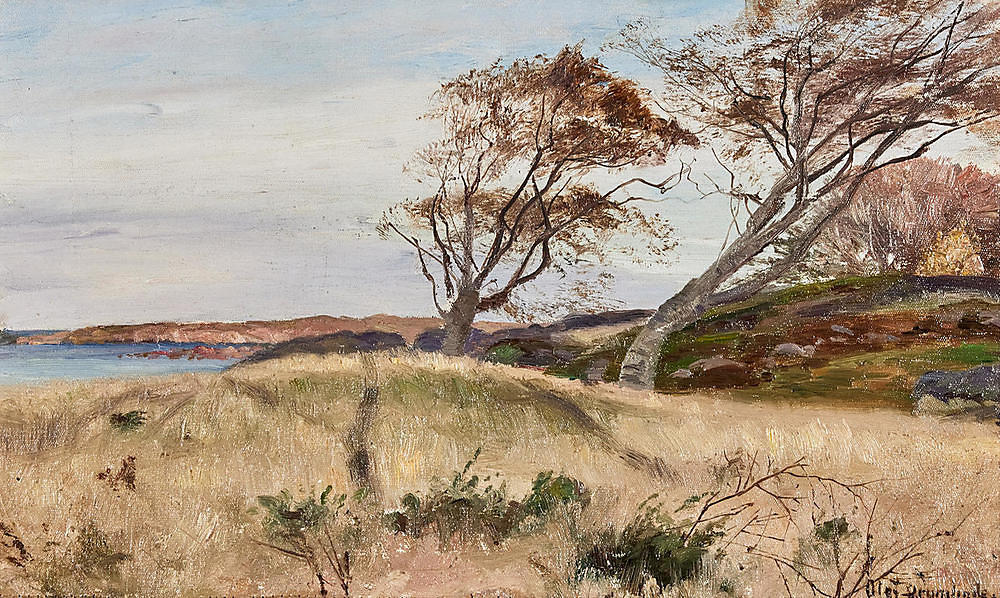
Torekov - Hallands Väderö, clubbed for 930 GBP at Stockholms Auktionsverk.
A Vision of the Swedish Countryside
Krumlinde’s work is characterized by its focus on natural landscapes and seascapes. His paintings capture the serene beauty of the Swedish countryside and coast with a sense of quiet observation. During the 1870s and 1890s, he frequently spent his summers in Halmstad, a period that resulted in several paintings of the city and its surroundings. His style, while rooted in the late 19th-century traditions of realistic and romantic landscape painting, was also influenced by the contemporary trends he encountered during his travels.
A Lasting Contribution to Swedish Art
Olof Krumlinde was an active participant in the Swedish art world, notably joining the "Opponenterna" movement in 1885. This group of artists famously challenged the conservative methods of the Royal Swedish Academy of Fine Arts, advocating for more modern and open artistic practices. His involvement with this movement highlights his commitment to progressive art ideas. Although he did not achieve the same level of international fame as some of his contemporaries, his work is held in respected collections, including the Nationalmuseum in Stockholm, a testament to his lasting contribution to Swedish art.