Howard Butterworth was born 1945 in Yorkshire, England, but built his artistic career in Scotland, where he became one of the country’s most beloved landscape painters. Trained at King’s College, Newcastle University, Butterworth studied fine art with a focus on painting and printmaking. Drawn to Scotland’s rugged beauty, he relocated to Aberdeenshire in the early 1970s, a move that would profoundly shape his subject matter and artistic identity.
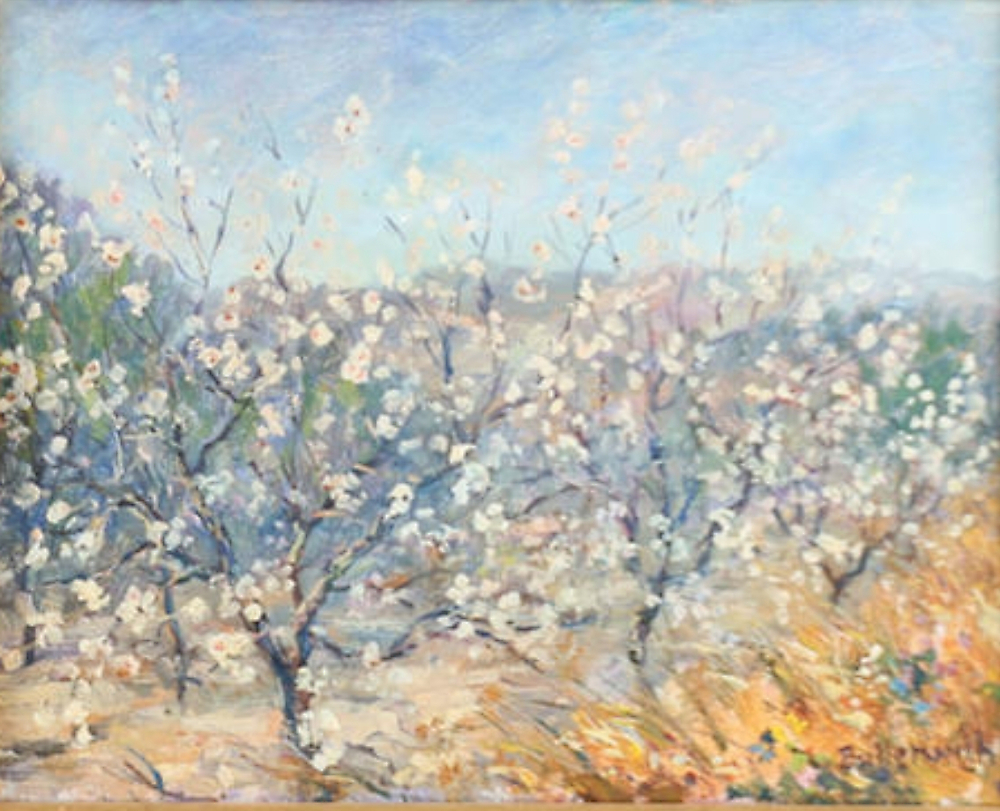
Almond tree in bloom, oil on panel and canvas.
Capturing the Scottish Landscape
Butterworth’s paintings are renowned for their luminous depictions of the Scottish Highlands, lowlands, and coastal scenes. Working primarily in oils, he developed a style that blends realism with a painterly sensitivity to light and atmosphere. His compositions often feature sweeping vistas, tranquil rivers, and dramatic skies, rendered with a depth and warmth that evoke the emotional resonance of place. Seasonal changes, from snow-covered hills to golden autumn glens, are a recurring theme, reflecting his deep engagement with the rhythms of nature. Beyond pure landscape, he occasionally includes figures and rural architecture, subtly integrating human presence into the grandeur of the land.
Recognition, Philanthropy, and Legacy
Butterworth’s work has been widely exhibited in galleries across Scotland and the UK, and his paintings are held in private and corporate collections worldwide. He has also used his art to support charitable causes, donating works to raise funds for environmental and community projects. His commitment to both his craft and the preservation of Scotland’s natural beauty has earned him admiration beyond artistic circles. Today, Howard Butterworth is celebrated not only for his mastery of landscape painting but also for his ability to convey the spirit and soul of Scotland. His works serve as enduring visual testaments to the power of place and the emotional connections we form with the land.