Carl Ludwig Jessen was born in Deezbüll, North Frisia, in what was then the Duchy of Schleswig, a region influenced by both Danish and German culture. Raised in a rural community, he developed an early appreciation for the everyday life and traditions of his surroundings. Recognising his talent, he enrolled at the Royal Danish Academy of Fine Arts in Copenhagen, where he studied under prominent artists of the mid-19th century. His academic training equipped him with a mastery of drawing, composition, and the use of light, while also instilling a respect for capturing life with authenticity.
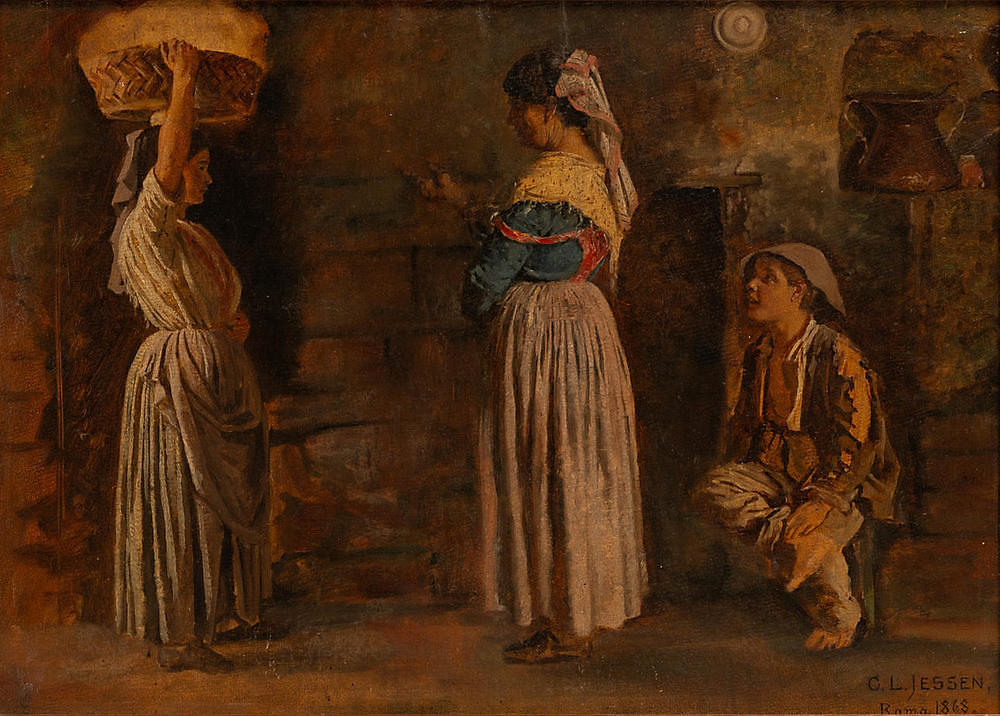
Italian interior, mother and daughter with laundry basket. Clubbed for 668 GBP at Stockholms Auktionsverk.
The “Frisian Painter” of Everyday Life
Jessen earned the affectionate title of the “Frisian painter” for his dedication to depicting the people, landscapes, and interiors of his native North Frisia. His works often portrayed farmers, fishermen, and domestic scenes with remarkable detail, offering an intimate look into rural life. He was meticulous in representing clothing, architecture, and the subtleties of light filtering through windows or across fields. While realistic in execution, his paintings carried a warmth and dignity that elevated his subjects beyond mere ethnographic study.
Legacy and Cultural Significance
Throughout his career, Jessen exhibited in Denmark and Germany, earning recognition for his ability to preserve the traditions of a region undergoing social and political change. His paintings have become an important visual record of 19th-century North Frisian culture, valued by historians and art lovers alike. Today, his works are held in museums and private collections, continuing to captivate audiences with their sincerity, craftsmanship, and cultural insight. Carl Ludwig Jessen remains a celebrated figure in German art history, admired for his commitment to truthfully portraying the life of his homeland.