Sol LeWitt was an American artist whose work bridged Minimalism and Conceptual Art, profoundly influencing the course of contemporary art. Born in 1928 in Hartford, Connecticut, LeWitt studied at Syracuse University before moving to New York City in 1953. He worked as a graphic designer for architect I.M. Pei before fully dedicating himself to art.

Form derived from a cube, clubbed for 2 025 GBP at Stockholms Auktionsverk.
LeWitt’s early work reflected the influence of Abstract Expressionism, but by the 1960s he had shifted to a more essentialist approach, focusing on seriality, geometry and modular structures. He became known for his wall drawings, sculptures and prints, which were often executed according to precise instructions, emphasising the idea over the hand of the artist.
Conceptual Art and Wall Drawings
LeWitt’s wall drawings are among his most celebrated contributions. These large-scale, site-specific works are created by teams of assistants following the artist’s instructions, blurring the boundaries between art and process. LeWitt’s use of grids, lines and geometric forms creates visually striking compositions that challenge traditional notions of authorship and originality.
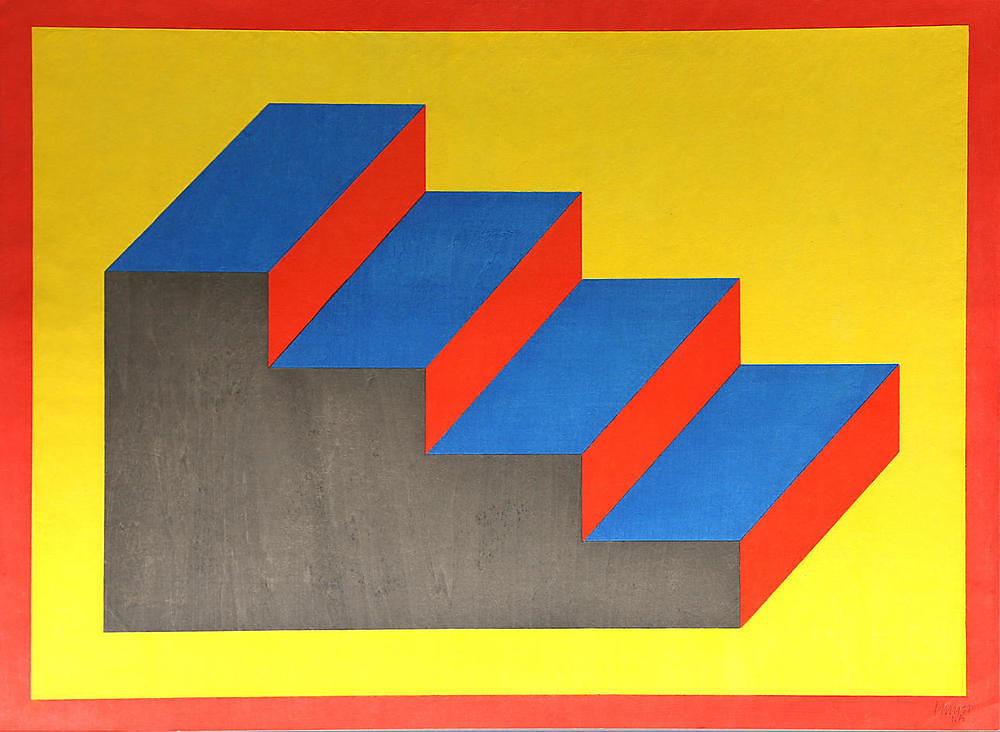
"A form driven from a rectangular solid".
Legacy and Global Influence
Sol LeWitt’s work has been exhibited in major museums worldwide and is held in prestigious collections. His innovative approach to art-making, prioritizing concept and process over individual expression, has inspired generations of artists and continues to shape contemporary art practices.