Gerda Marie Fredrikke Wegener (née Gottlieb) was a Danish painter and illustrator whose work remains celebrated for its bold exploration of gender, sexuality and the modern woman. Born in Hammelev, Denmark, in 1886, Wegener pursued her artistic ambitions at the Royal Danish Academy of Fine Arts in Copenhagen, where she developed her distinctive style and met her future husband, Einar Wegener.
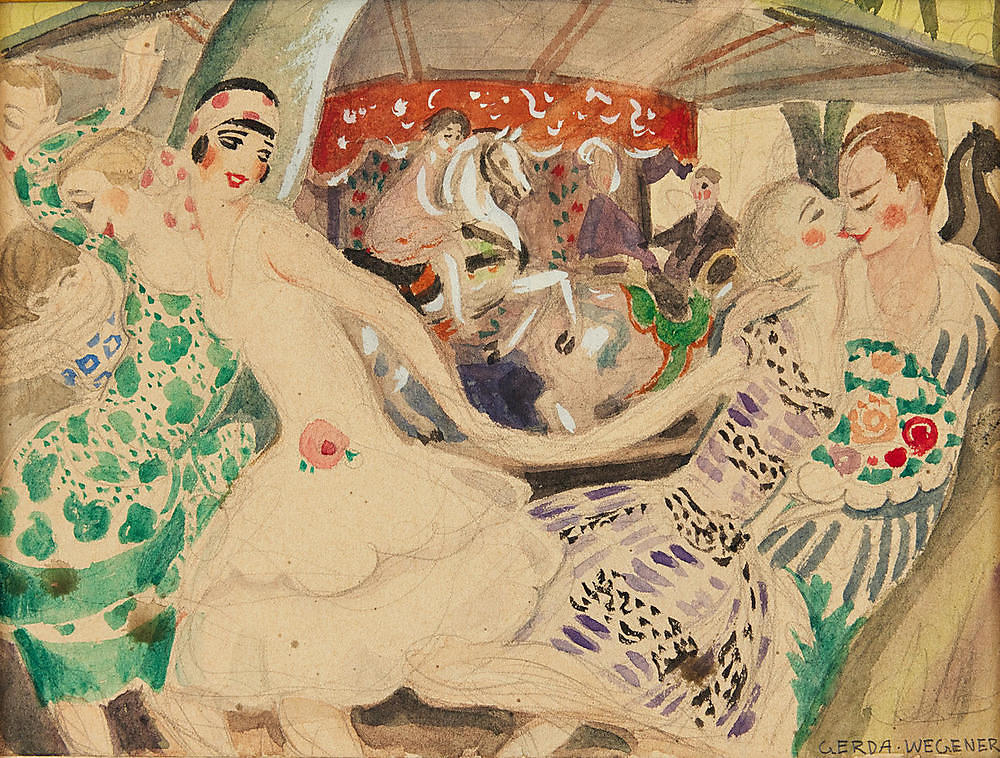
“Scene from the Bakken”, clubbed for 10 135 GBP at Stockholms Auktionsverk.
Artistic Style and Career
Wegener’s art is characterised by its elegant, confident depictions of women, often rendered in the styles of Art Nouveau and Art Deco. She portrayed women engaged in a variety of activities – from theatre and dance to more intimate and risqué scenes – challenging traditional gender roles and societal expectations. Her fashion illustrations and paintings were published in leading Parisian fashion magazines such as Vogue and La Vie Parisienne, and she gained a reputation for her striking, sensuous images of modern women.
Her work was not only commercially successful but also critically acclaimed; she exhibited at prestigious salons in Paris, including the Salon des Humoristes, Salon des Indépendants, and Salon d’Automne. In 1925, she won gold medals at the International Exhibition of Modern Decorative and Industrial Arts for her stained-glass windows and illustrations.
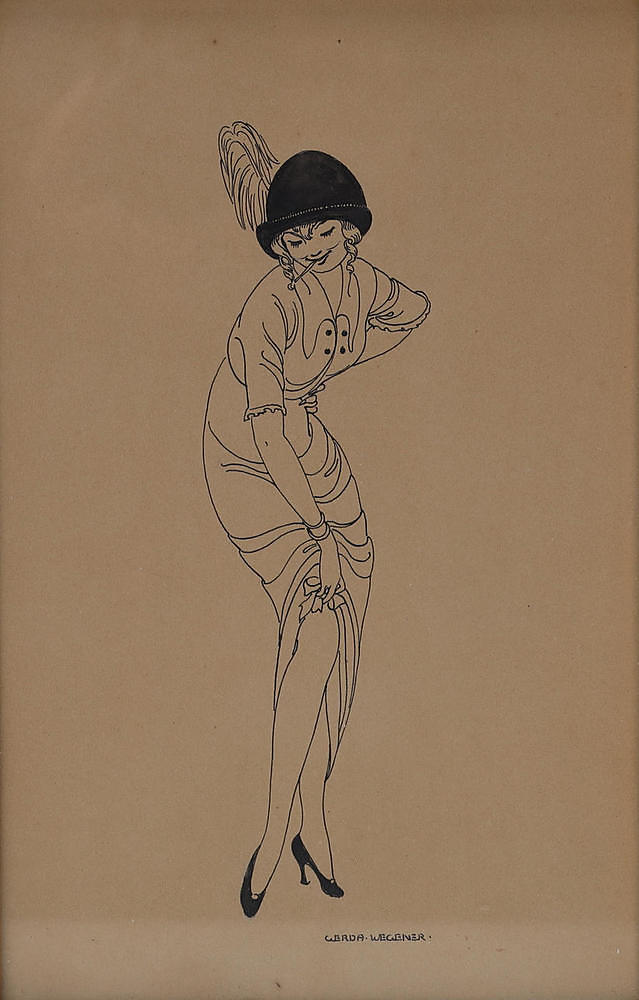
Portrait of a woman, pen on paper.
Art Deco Elegance and Queer Representation
Wegener’s art combines fine draughtsmanship with decorative stylisation. Her subjects are portrayed with poise, sensuality, and wit, framed by geometric patterns and luminous colours. As a pioneering figure in queer art history, her work continues to inspire discussions on gender, identity, and representation.
Wegener’s life and art were profoundly shaped by her relationship with her husband, Einar Wegener, who later became Lili Elbe, one of the first known recipients of gender reassignment surgery. Lili became both muse and collaborator, inspiring many of Gerda’s most famous works and serving as a model for her portraits. Wegener’s willingness to explore themes of love, identity, and desire through her art was revolutionary for her time. Though her later years were marked by financial hardship and relative obscurity, her legacy has grown in recent decades, with her work now recognised for its pioneering role in the history of gender and art. She died in Copenhagen in 1940.