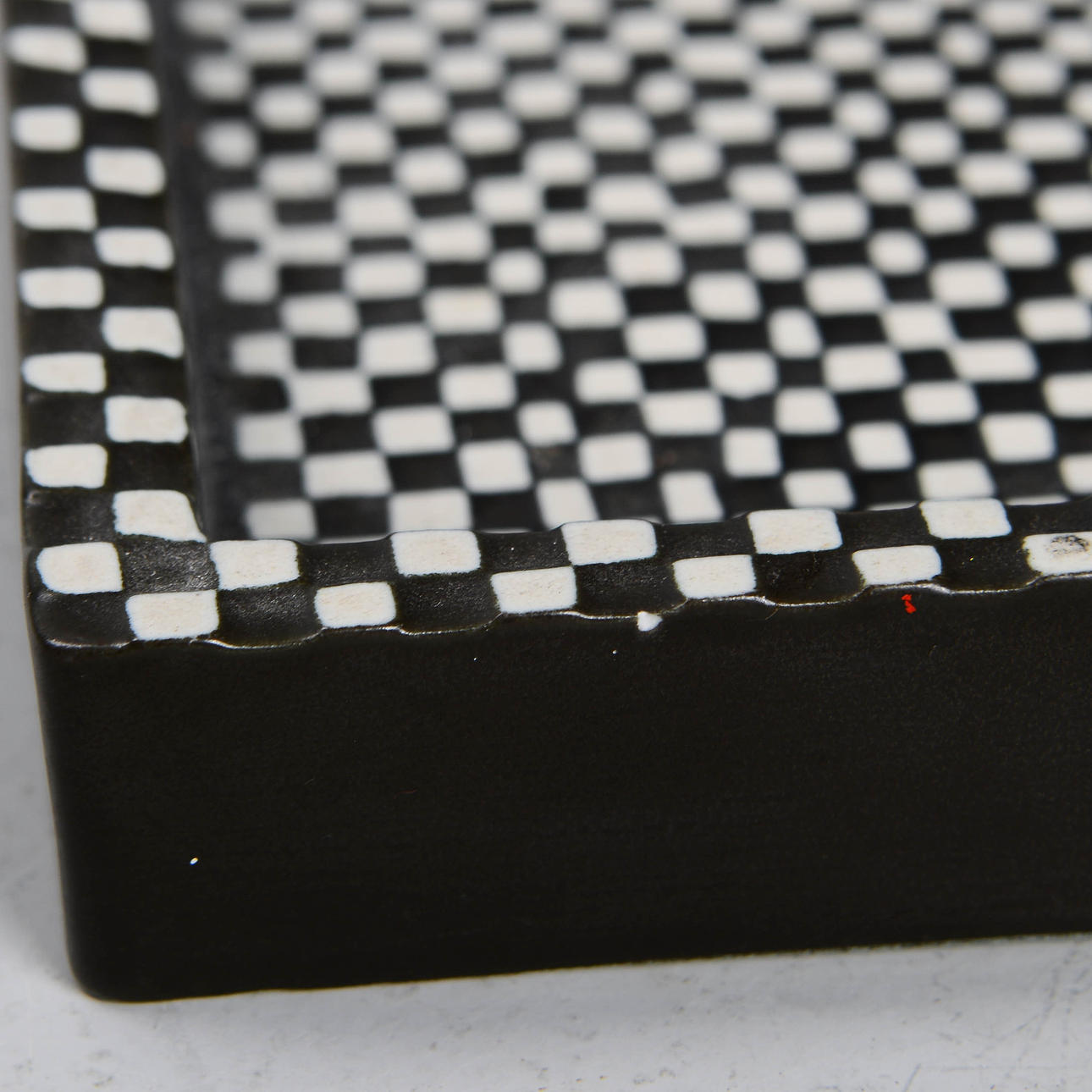
"Domino", dish, Gustavsberg, 1955-69.

Images





Description
Stoneware. 15 x 15 cm.
Stig Lindberg was a Swedish multi-artist, designer, and illustrator born on August 17, 1916, in Umeå and died on April 7, 1982, in San Felice Circeo, Italy. After his studies at the Technical School in Stockholm (now Konstfack), he worked for the majority of his life at Gustavsberg Porcelain Factory.
In 1937, at only 21 years of age, Lindberg received his first employment at Gustavsberg Porcelain Factory. He was hired as an assistant to Wilhelm Kåge, the then artistic director. Kåge already held an established position within design and was one of the most influential Swedish ceramicists. During his time as an assistant to Kåge, Lindberg had the opportunity to learn and refine his technical skills in ceramic design. He explored various styles and modes of expression and gradually developed his own unique style.
When Kåge retired in 1949, Stig Lindberg took over the role of artistic director at Gustavsberg. As artistic director, Lindberg renewed Gustavsberg's design and shifted the focus from traditional and formal design to more modern and experimental expressions. He became known and successful for his innovative style, and his works often displayed a combination of modernist elements, playfulness, and humor.
The "Domino" pattern was introduced in the 1950s and is characterized by geometric shapes and patterns in various colors and sizes. It usually consists of squares or rectangles placed next to each other in a repeating pattern structure. The color palette varies, but strong contrasting colors such as black and white are usually used, although other color schemes exist.
Condition
A few micro-chips/glaze flaws.
Theme
Description
Stoneware. 15 x 15 cm.
Stig Lindberg was a Swedish multi-artist, designer, and illustrator born on August 17, 1916, in Umeå and died on April 7, 1982, in San Felice Circeo, Italy. After his studies at the Technical School in Stockholm (now Konstfack), he worked for the majority of his life at Gustavsberg Porcelain Factory.
In 1937, at only 21 years of age, Lindberg received his first employment at Gustavsberg Porcelain Factory. He was hired as an assistant to Wilhelm Kåge, the then artistic director. Kåge already held an established position within design and was one of the most influential Swedish ceramicists. During his time as an assistant to Kåge, Lindberg had the opportunity to learn and refine his technical skills in ceramic design. He explored various styles and modes of expression and gradually developed his own unique style.
When Kåge retired in 1949, Stig Lindberg took over the role of artistic director at Gustavsberg. As artistic director, Lindberg renewed Gustavsberg's design and shifted the focus from traditional and formal design to more modern and experimental expressions. He became known and successful for his innovative style, and his works often displayed a combination of modernist elements, playfulness, and humor.
The "Domino" pattern was introduced in the 1950s and is characterized by geometric shapes and patterns in various colors and sizes. It usually consists of squares or rectangles placed next to each other in a repeating pattern structure. The color palette varies, but strong contrasting colors such as black and white are usually used, although other color schemes exist.
Condition
A few micro-chips/glaze flaws.
Theme
Payment options for this item
Payment cardsBank transferDelivery
: Provide your locationInfo temporarily unavailableLoading…Provide your location to see transport options and prices.
Oops! Something went wrong.
Please try again in a moment. If it still doesn't work, contact Auctionet support.
Details
- House
- Formstad Auktioner
- Address
Gårdsfogdevägen 16
168 67 Bromma
Sweden- Placement
- Vagn 001