PEARL NS-97E FLUTE 925 STERLING SILVER.
This auction is closed, but maybe you like the following items?

Images




Description
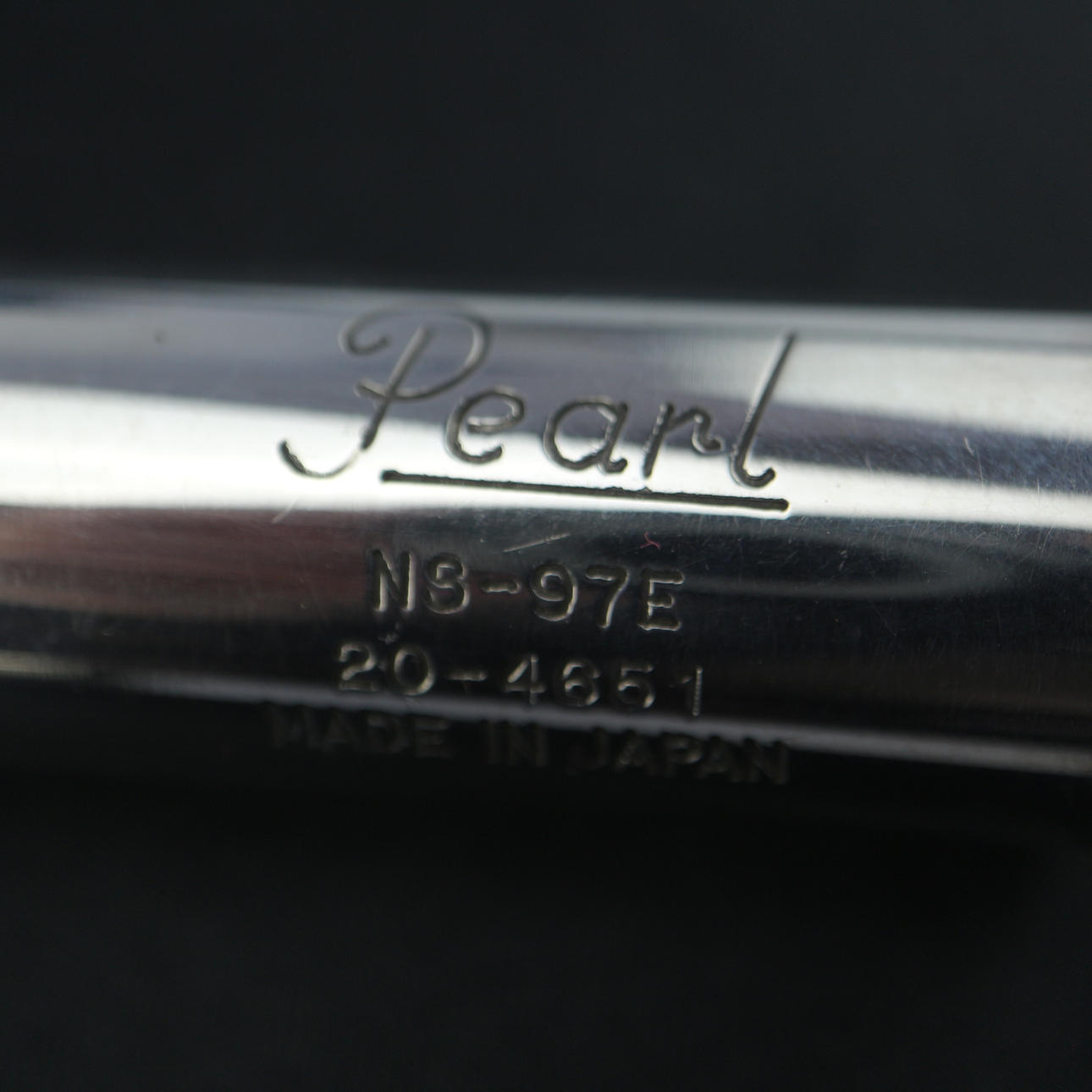
Pearl NS-97 E flute, 925 sterling silver, 406 gr, made in Japan, 20 - 4651 model, 1980, with E mechanism, including case.
Dimensions in case: 37.5 x 8.5 cm.
In 1968, the Japan-based Pearl Musical Instrument Co. a workshop for the production of transverse flutes. The following year, the workshop was relocated to Yachiyo City, Chiba Prefecture. The production of the Pearl flutes was still managed today (!) Tatsumi Shimoyama, who works for Pearl and is responsible for the quality standard of the flutes. Shimoyama had learned flute making from Muramatsu. Pearl flutes came onto the German market in 1971, shortly after Yamaha. Just like Yamaha, they started with student flutes. The first models were NC-96 (silver plated) and NS-97 (silver head) series instruments. Just like the Yamaha flutes, they were quickly known for a good price/quality ratio and for an unusually consistent build quality within the large series. Pearl flutes were the only serious competition for rising giant Yamaha in this segment. European manufacturers of student flutes such as Grassi (Italy), Noblet (France) and Schreiber (West Germany) were unable to cope with the competitive pressure and soon stopped producing student flutes.
When Tatsumi Shimoyama started making his own flutes, he did things differently from all established manufacturers.
A trademark of the Pearl flute right from the start has been its "pinless construction". Traditionally, a portion of the keys is rigidly connected to the steel axle by small steel pins (“pinned mechanics”) to transmit movement from one end of the axle to the other without affecting the keys between them. Pearl does not use these pins at all. They are partly connected to the central axis using grub screws (right hand, trill keys), partly by using a bridge mechanism (connection B key/B trill lever). Anyone who has to knock out rusted or too short pins (if possible without visible traces) in order to disassemble the mechanics of a flute appreciates this. The bridge mechanism also reduces unnecessary friction: the Danish flute maker Johan Brögger discovered the bridge mechanism for the high-end range. Since then z. B. Brannen-Cooper and Miyazawa in the professional field of bridge mechanics, which in principle follow Pearl's ideas.
Another construction feature that distinguished the Pearl flutes from the beginning is the so-called "one piece core bar".
This is about the long axis on the upper part of the flute, which carries a large part of the key mechanism. Some flutes with a traditional three-part shaft can have problems with wear in two places. First: where the short axis that carries the small C-key forms the bearing for the B-key. Second: on the middle bracket ("king post"), which forms the bearing for the mechanics of the left and right hand. This danger is reduced by the two-part axle structure with a long main axle ("one piece core bar"), which extends from the C-key through the upper bracket down to the "king post". Its tip forms the bearing for the axis of the keys of the right hand. The axle brackets no longer carry as much load, they only provide guidance.
Of course, what has advantages also has disadvantages. Service technicians sometimes grumble about the fact that the entire flap mechanism is accommodating when they actually only want to remove one flap. But I can live with that.
Condition
Signs of age and wear, see pictures.
Do you have something similar to sell? Get your items valued free of charge!
Description
Pearl NS-97 E flute, 925 sterling silver, 406 gr, made in Japan, 20 - 4651 model, 1980, with E mechanism, including case.
Dimensions in case: 37.5 x 8.5 cm.
In 1968, the Japan-based Pearl Musical Instrument Co. a workshop for the production of transverse flutes. The following year, the workshop was relocated to Yachiyo City, Chiba Prefecture. The production of the Pearl flutes was still managed today (!) Tatsumi Shimoyama, who works for Pearl and is responsible for the quality standard of the flutes. Shimoyama had learned flute making from Muramatsu. Pearl flutes came onto the German market in 1971, shortly after Yamaha. Just like Yamaha, they started with student flutes. The first models were NC-96 (silver plated) and NS-97 (silver head) series instruments. Just like the Yamaha flutes, they were quickly known for a good price/quality ratio and for an unusually consistent build quality within the large series. Pearl flutes were the only serious competition for rising giant Yamaha in this segment. European manufacturers of student flutes such as Grassi (Italy), Noblet (France) and Schreiber (West Germany) were unable to cope with the competitive pressure and soon stopped producing student flutes.
When Tatsumi Shimoyama started making his own flutes, he did things differently from all established manufacturers.
A trademark of the Pearl flute right from the start has been its "pinless construction". Traditionally, a portion of the keys is rigidly connected to the steel axle by small steel pins (“pinned mechanics”) to transmit movement from one end of the axle to the other without affecting the keys between them. Pearl does not use these pins at all. They are partly connected to the central axis using grub screws (right hand, trill keys), partly by using a bridge mechanism (connection B key/B trill lever). Anyone who has to knock out rusted or too short pins (if possible without visible traces) in order to disassemble the mechanics of a flute appreciates this. The bridge mechanism also reduces unnecessary friction: the Danish flute maker Johan Brögger discovered the bridge mechanism for the high-end range. Since then z. B. Brannen-Cooper and Miyazawa in the professional field of bridge mechanics, which in principle follow Pearl's ideas.
Another construction feature that distinguished the Pearl flutes from the beginning is the so-called "one piece core bar".
This is about the long axis on the upper part of the flute, which carries a large part of the key mechanism. Some flutes with a traditional three-part shaft can have problems with wear in two places. First: where the short axis that carries the small C-key forms the bearing for the B-key. Second: on the middle bracket ("king post"), which forms the bearing for the mechanics of the left and right hand. This danger is reduced by the two-part axle structure with a long main axle ("one piece core bar"), which extends from the C-key through the upper bracket down to the "king post". Its tip forms the bearing for the axis of the keys of the right hand. The axle brackets no longer carry as much load, they only provide guidance.
Of course, what has advantages also has disadvantages. Service technicians sometimes grumble about the fact that the entire flap mechanism is accommodating when they actually only want to remove one flap. But I can live with that.
Condition
Signs of age and wear, see pictures.
Do you have something similar to sell? Get your items valued free of charge!