Meillä ei valitettavasti ole hakuasi vastaavia esineitä.
- Teema- ja vasarahuutokaupat
- /
- Good Art XIX - Summer
Good Art XIX - Summer
SuodataSuodata ja lajittele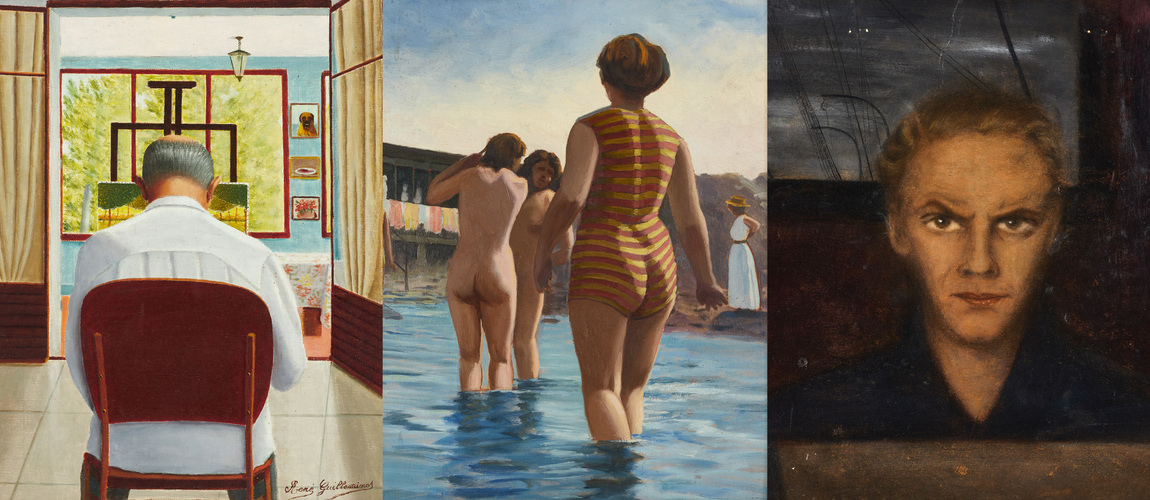
Good Art XIX - Summer
31 heinä 2026 · Crafoord Auktioner Stockholm
Crafoord Auktioner Stockholm presents the themed auction Good Art XIX where this month's selection of interesting artists and works is highlighted. These deserve to be included in a context and hopefully brighten up many walls.
We are now taking a stand for art and are showcasing over 200 works by artists such as: Jockum Nordström, Roberto Matta, Jean Cocteau, Ragnar Persson, Max Ernst, Lage Lindell, Pablo Picasso, Jim Dine, Bernard Buffet, Kjartan Slettermark, Axel Fridell, Wilhelm Kåge, Hundertwasser, Akseli Gallen-Kallela and others.
Highlights include the self-portraits of Hans Hedberg and René Guillemont, Lars Boëthius' powerful painting from 1938, Bengt Borg's Woman with a Collar and Harald Lindberg's "In the Bright Night" (1955). Among the most prominent works are also Cecilia Sjölund's painting Aloof / Distanserad, which was exhibited at the London Art Biennale 2023, as well as Tomas Segebladh's photographs of Kristina Lugn.
The theme also includes two smaller presentations with paintings by French artists Georges Laporte (1926–2000) and Lars Norrman (1915–1979). Graffiti artists Iron and Oliw87 also contribute with a number of colourful original works with messages.
Among the other gems of the theme are several paintings by unknown artists, including auction numbers 5143835 – Motif from Capri (1911), 5176029 and 5138768 – Portraits and 5150876 – Seaside Baths.
The name Good Art has been used in other contexts before. In 1941, the exhibition “GOD KONST I ALLA HEM” opened under the auspices of HSB. The aim of the exhibition was to promote good art in homes. The preface to the catalogue states that it is not enough to build good homes; art must also find its place. The main principle was to offer good art to a wider public at affordable prices. To guarantee that the art was truly “good”, a jury of famous artists and art critics was engaged. They were asked to review the works of art that were to be exhibited. The result was that, for example, it was possible to buy GAN's oil painting Berns 1918 for 5,000 kronor, the tempera Ratten for 350 kronor and Laboratorium for 500 kronor. Other names included in the art for the people project included Oskar Bergman, Einar Jolin, Arne Jones, Isaac Grünewald, Sixten Lundbohm, Erik and Axel Olson. The exhibition's 10th anniversary was shown at Liljevalchs konsthall in Stockholm.
In the same year, 1941, Gunnar Hjorthén (1913–1997) opened Galleri God Konst on Vallgatan in Gothenburg. He came to be considered something of an institution in Gothenburg's art scene. The gallery gradually moved to Drottninggatan, Konserthuset and Södra vägen, among others. Hjorthén devoted himself to promoting and highlighting "young art" with artists such as Ivan Ivarson, Karin Parrow, Ragnar Sandberg and Inge Schiöler. Thanks largely to Hjorthén and Galleri God konst, Gothenburg Colorism became a concept. Like the Swedish-French Art Gallery, Hjorthén sought out Paris early on and through the gallery established contact with the new painting. In 1953, for example, Tsugoharu Foujita was exhibited.
Welcome to the viewing and be inspired.
Käynnissä olevat huutokaupat
Tässä ovat arkistossamme olevat esineet, jotka vastaavat hakuasiNäytä kaikki esineet