Meillä ei valitettavasti ole hakuasi vastaavia esineitä.
- Teema- ja vasarahuutokaupat
- /
- Edvard Andersson - a modern colour explosion: Part II
Edvard Andersson - a modern colour explosion: Part II
SuodataSuodata ja lajittele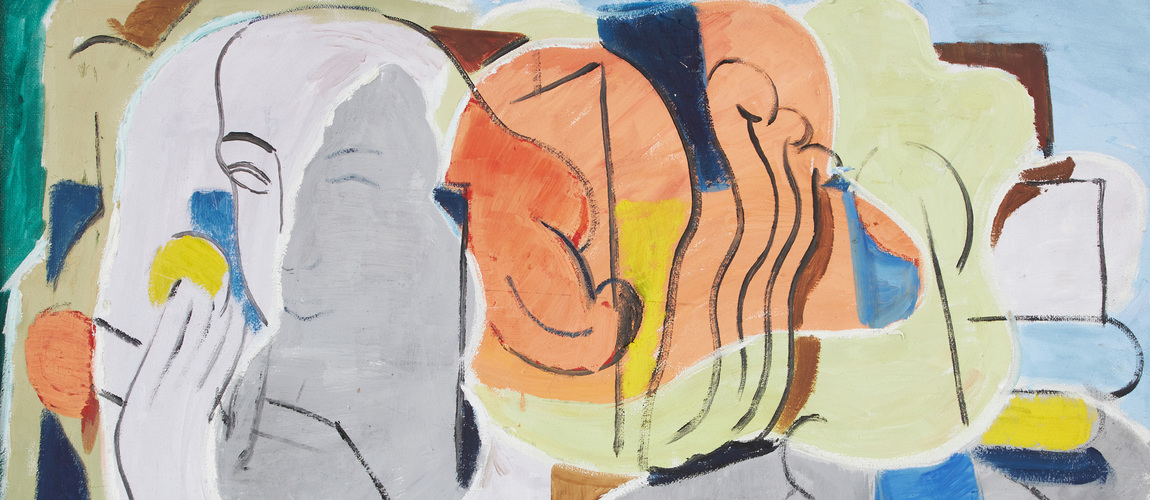
Edvard Andersson - a modern colour explosion: Part II
26 elo 2024 · Stockholms Auktionsverk Fine Art
Edvard Andersson lived between 1891 and 1967 and witnessed the birth, breakthrough, and development of modernism during his lifetime. With an open mind and a deep interest in the essence of art and its multifaceted expressions, he actively followed and was inspired by the international art scene throughout his life. The result is a powerful oeuvre by a confident and experimental modernist. The artist Edvard Andersson deserves to be highlighted and admired, and Stockholms Auktionsverk is therefore proud to present “Edvard Andersson – a Modern Color Explosion, Part II,” a collection directly from the artist's family.
Andersson, who grew up in the working-class neighborhoods of Helsingborg, displayed a distinct talent for drawing during his childhood. His parents, who ran a tobacco shop, managed to save enough money to support his journey to Stockholm in 1916, where he trained as an art teacher at the Higher School of Art and Design, now Konstfack. In 1918, at the age of 27, Andersson held his first exhibition at Killbergs Art Salon in Helsingborg. After graduating, he worked as an art teacher, a profession he maintained alongside his artistic career, allowing him to approach painting without financial pressure. This resulted in a free and independent expression.
In the 1920s and 1930s, Andersson focused on portraiture with a cubist approach, which led him to explore abstract painting in the 1940s. By the 1950s, he confidently embraced this style, creating abstract, vibrant compositions with decorative linear forms on increasingly larger canvases. Often, these works include figurative elements, such as stylized women or suggestive movements. While no specific influencer should be singled out, parallels can be drawn to the work of Gösta Adrian-Nilsson, whose art was inspired by the international avant-garde, which Andersson closely followed.
In 1956, around 500 of Andersson's works were showcased in a major solo exhibition at the prestigious “Den Frie Udstillning” in Copenhagen. Many of the works now being auctioned at Stockholms Auktionsverk were part of that exhibition, including "Kalejdoskop," "Rythmus," and "Havsgeometri." These pieces feature kaleidoscopic compositions that blur the sense of time and space, merging the concrete with the abstract. Skåne remained Andersson's home base. He lived in the culturally rich city of Helsingborg, had a summer studio at the dramatic Hovs Hallar, and connected with other artists and cultural figures in the fishing village of Knäbäck on Österlen. Andersson was one of those artists who truly “lived with a pen in hand.” His family has shared that he would keep drawing during Sunday dinners and walks, a testament to both his calling and passion. In addition to art, Andersson was interested in philosophy, mathematics, and, above all, the people around him, which is evident in the personal interpretation of his work.
During his lifetime, Edvard Andersson was a largely unknown figure to the broader public. Besides the exhibitions mentioned above, he held exhibitions in Stockholm and Malmö, as well as posthumously in Paris and Florida. Andersson received more recognition abroad than in Sweden, with mentions in leading journals such as “La Quotidienne,” “Le Peintre,” “Nouveaux Jours,” and “La Revue.” Finally, in Sweden, the spotlight is once again on him, with this auction’s exhibition allowing us to follow his artistic phases. We welcome you to Nybrogatan 32!
Käynnissä olevat huutokaupat
Tässä ovat arkistossamme olevat esineet, jotka vastaavat hakuasiNäytä kaikki esineet