Johan Gustaf von Holst was a Swedish painter and military officer, primarily known for his charming and detailed animal paintings, especially dogs and foxes. Born in Stockholm in 1841, von Holst had a dual career; he was a major in the army, serving in the Livgardet till häst (Life Regiment on Horseback), and also a dedicated artist. He studied art at the Royal Academy of Fine Arts (Kungliga Konstakademien) in Stockholm, where he was a student of Nils Andersson. His work reflects the academic and naturalistic ideals prevalent in 19th-century Swedish art.
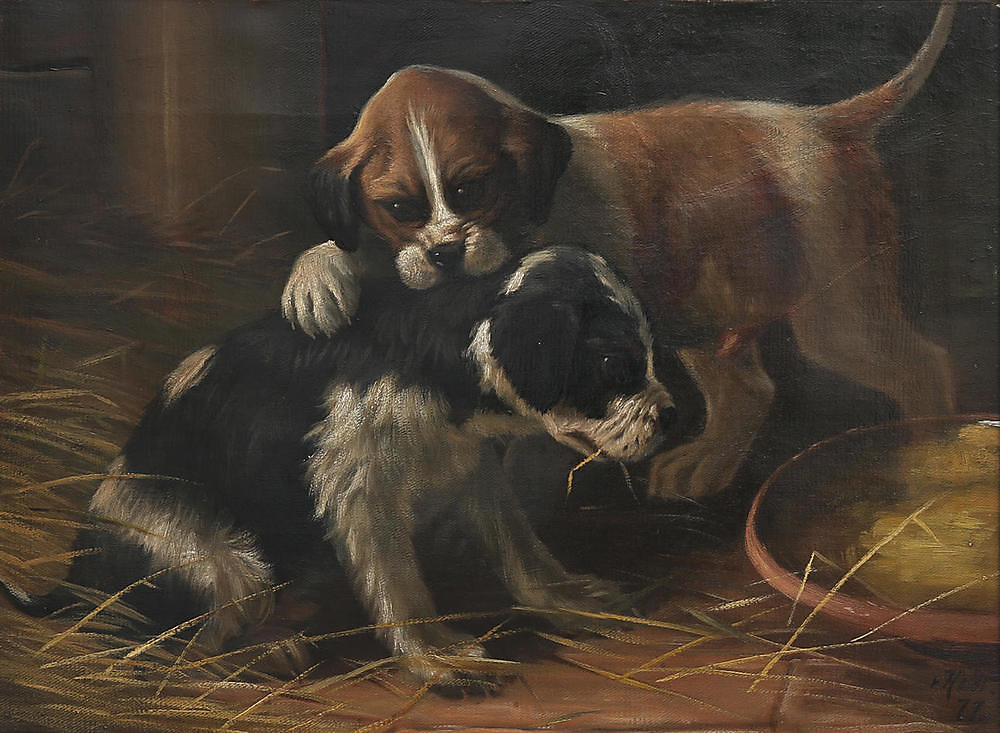
"Puppies at Food Bowls", clubbed for 673 GBP at Crafoord Auktioner Lund.
Mastering Animal Portraiture and Genre Scenes
Von Holst’s artistic output was largely devoted to capturing the character and dignity of animals. He frequently depicted dogs, often puppies, in endearing and lively poses, as well as foxes and other wildlife, demonstrating a keen observational eye and a sensitive hand. While he painted a variety of genre scenes and occasionally portraits, it is his animal motifs that truly set him apart and for which he gained recognition. His ability to render textures, light, and the expressions of his animal subjects with precision gave his paintings a warmth and appeal that resonated with contemporary audiences and continues to attract collectors today.
Legacy and Recognition
During his lifetime, Johan Gustaf von Holst exhibited widely and was respected within Sweden’s academic art circles. His paintings were acquired by collectors and institutions, and his contribution to 19th-century Swedish painting remains appreciated among connoisseurs of traditional academic art. Today, his works are occasionally seen at auction, often drawing interest from those passionate about historical and genre painting in the Scandinavian tradition. He is notably represented in the collection of the Hallwyl Museum (Hallwylska museet) in Stockholm.