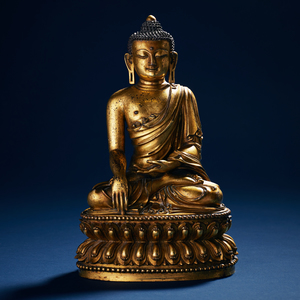
1036. An Important Chinese Gilt-Bronze Figure of Shakyamuni Buddha.
This auction is closed, but maybe you like the following items?

Images


Description
Finely cast seated in dhyanasana upon a double lotus throne with beaded edges, his right hand reaching down in the earth-touching bhumisparsha mudra, and his left hand resting in his lap revealing a lotus flower which is rendered in relief in his palm, a plain robe draped across his chest, leaving the right shoulder bare, and over the somewhat pinched waist, falling in crisp, elegant folds around his body, his rounded face with downcast eyes and a gentle smile forming a benevolent expression, a raised urna centering his forehead between the arched brows, flanked by large ears with pierced pendulous lobes, his hair with traces of pigment, the hair covering the ushnisha which is topped by a knob finial, the figure with rich and thick gilding, sealed with a copper plate with remains of red pigment and engraved with a double vajra (visvavajra). Period: Yongle (1403-1424). Height c. 18.8 cm.
Provenance
Acquired privately by the present owner around 40 years ago in Uppsala, Sweden.
Note
Having seen the ’four sights’ of aging, sickness, death, and asceticism, Siddhartha Gautama renounced his princely life in search of truth. He devoted himself to severe ascetic practices and deep meditation, but eventually became disillusioned with such extremes. Leaving his ascetic companions behind, he wandered through northern India until he reached the Bodhi tree on the banks of the Phalgu River. There, seated beneath the tree, he entered a profound meditation. During this time, the demon Mara tried to distract him, unleashing both his fearsome armies and his alluring daughters. Gautama remained unaffected by these worldly temptations, and moved his right hand from a meditative position to touch the ground before him. With this gesture, he called upon the earth to witness his claim to enlightenment.
This is perhaps the most iconic moment in the life of Siddharta Gautama, called Shakyamuni Buddha, the Historical Buddha. The present figure captures this occasion with the Buddha on the very threshold of enlightenment. The artisan has depicted him as a young aristocrat. With broad shoulders, plump features, and soft contours of the limbs, the Buddha is far removed from his previous ascetic endeavours. Although in human form, there are indications announcing his divine nature, such as his cranial bump (ushnisha), symbolising the attainment of spiritual enlightenment, and the raised point (urna) between his eyebrows, a physical manifestation of perfected wisdom. His pendulous earlobes, stretched out by the heavy earrings he used to wear as a prince, represent his rejection of worldly goods. As does the monk's robe in its 'sacred simplicity', emphasising the Buddha’s spiritual, rather than earthly, significance.
During the early Ming dynasty, emperors were enthusiastic patrons of Buddhism. The Hongwu Emperor (r. 1368-1398) had lived as a monk from about age seventeen to twenty-four, and his successors, the Yongle (r. 1402-1424) and Xuande (r. 1425-1435) Emperors, continued to promote Tibetan Buddhism, both out of devotion and as a strategy to expand imperial influence. The Yongle Emperor in particular welcomed Tibetan dignitaries with elaborate ceremonies and lavish gifts, and as early as 1403, he dispatched Imperial delegations to Tibet.
After the fall of the Yuan dynasty, many Tibetan artisans who had served under Mongol rule are believed to have remained in Beijing, continuing their work in the Ming Imperial Workshops. Although Tibetan-influenced art flourished during the reigns of Yongle and Xuande, Tibetan Buddhism was likely practiced by few outside the imperial court, meaning most works of religious art were created for imperial use. The Yongle Emperor, a devout Buddhist, commissioned gilt-bronze sculptures bearing his reign mark, both for his own religious devotion and as diplomatic gifts to Tibetan envoys. Such sculptures are considered masterpieces of Tibeto-Chinese art.
Bronze sculptures from this period, which range approximately 15 to 28 cm in height, are today rare, and appear with an engraved six-character mark of Yongle. Although the present example bears no Imperial mark, it is a fine example of Buddhist sculpture from the Yongle period. The artisan has painstakingly rendered both the front and back of the figure in exquisite detail - the elegant draping of the robe, the poise of the fingers, the finely rendered ears, the lotus flower in the palm and the throne with its slender lotus petals and beaded edges. These details distinguish the figure as a particularly noteworthy example of this size and period.
The present figure is closely related to a figure from the collection of Henrik Valdemar Jacobsen (1887-1955) sold at Bonhams London, Live Auction: Fine Chinese Art, 18 May 2023, lot 40. The Jacobsen Buddha bears a six-character mark of Yongle and is of the period, resulting in a wider throne to give space for the mark. Apart from the Jacobsen Buddha being c. 2 cm taller than the present figure, they are near-indistinguishable. The two figures are sealed with copper plates bearing a similar double vajra, making it highly likely that they were created in the same workshop. Further related examples include a Yongle mark and period figure at Sotheby’s Hong Kong, Live Auction: The Heart of Tantra – Buddhist Art Including Property from the Nyingjei Lam Collection, 3 October 2017, lot 3143, and a shrine of impressive proportions (total 60.5 cm tall), bearing a six-character mark of Yongle, in the British Museum, acc. no 1908,0420.4.
Commemorating the defeat of Mara, and the victory of spiritual liberation, the present figure is a testament to the consummate skill of artisans of the Yongle period, and is amongst the finest ever made during the first half of the 15th century. This ultimate representation of Shakyamuni Buddha, is undoubtably the highlight of this sale, and would be a cornerstone in any major collection of Buddhist art.
The superb quality, unsurpassed proportions and the lavish gilding makes this newly discovered sculpture an important example of Yongle art.
We would like to extend our sincere gratitude to Karl Gunnar Gardell for his expertise and for assisting us in the cataloguing of this lot.
Condition
General wear, minor surface stains/spots. Some losses of gilding, primarily to the right arm, shoulder and chest. The gilding with tiny 'bubbles'. Some scratches and surface marks, the back of the upper right arm with an area where the gilding has been scratches away. Tiny dent marks around the lower edge of the base. A few of the hair curls indented. Otherwise very good condition consistent with age and use. The base plate does not seem to have ever been removed or replaced, with the original consecration material still rattling inside. Total weight c. 1220 grams.
Sale
Do you have something similar to sell? Get your items valued free of charge!
Bidding
Description
Finely cast seated in dhyanasana upon a double lotus throne with beaded edges, his right hand reaching down in the earth-touching bhumisparsha mudra, and his left hand resting in his lap revealing a lotus flower which is rendered in relief in his palm, a plain robe draped across his chest, leaving the right shoulder bare, and over the somewhat pinched waist, falling in crisp, elegant folds around his body, his rounded face with downcast eyes and a gentle smile forming a benevolent expression, a raised urna centering his forehead between the arched brows, flanked by large ears with pierced pendulous lobes, his hair with traces of pigment, the hair covering the ushnisha which is topped by a knob finial, the figure with rich and thick gilding, sealed with a copper plate with remains of red pigment and engraved with a double vajra (visvavajra). Period: Yongle (1403-1424). Height c. 18.8 cm.
Provenance
Acquired privately by the present owner around 40 years ago in Uppsala, Sweden.
Note
Having seen the ’four sights’ of aging, sickness, death, and asceticism, Siddhartha Gautama renounced his princely life in search of truth. He devoted himself to severe ascetic practices and deep meditation, but eventually became disillusioned with such extremes. Leaving his ascetic companions behind, he wandered through northern India until he reached the Bodhi tree on the banks of the Phalgu River. There, seated beneath the tree, he entered a profound meditation. During this time, the demon Mara tried to distract him, unleashing both his fearsome armies and his alluring daughters. Gautama remained unaffected by these worldly temptations, and moved his right hand from a meditative position to touch the ground before him. With this gesture, he called upon the earth to witness his claim to enlightenment.
This is perhaps the most iconic moment in the life of Siddharta Gautama, called Shakyamuni Buddha, the Historical Buddha. The present figure captures this occasion with the Buddha on the very threshold of enlightenment. The artisan has depicted him as a young aristocrat. With broad shoulders, plump features, and soft contours of the limbs, the Buddha is far removed from his previous ascetic endeavours. Although in human form, there are indications announcing his divine nature, such as his cranial bump (ushnisha), symbolising the attainment of spiritual enlightenment, and the raised point (urna) between his eyebrows, a physical manifestation of perfected wisdom. His pendulous earlobes, stretched out by the heavy earrings he used to wear as a prince, represent his rejection of worldly goods. As does the monk's robe in its 'sacred simplicity', emphasising the Buddha’s spiritual, rather than earthly, significance.
During the early Ming dynasty, emperors were enthusiastic patrons of Buddhism. The Hongwu Emperor (r. 1368-1398) had lived as a monk from about age seventeen to twenty-four, and his successors, the Yongle (r. 1402-1424) and Xuande (r. 1425-1435) Emperors, continued to promote Tibetan Buddhism, both out of devotion and as a strategy to expand imperial influence. The Yongle Emperor in particular welcomed Tibetan dignitaries with elaborate ceremonies and lavish gifts, and as early as 1403, he dispatched Imperial delegations to Tibet.
After the fall of the Yuan dynasty, many Tibetan artisans who had served under Mongol rule are believed to have remained in Beijing, continuing their work in the Ming Imperial Workshops. Although Tibetan-influenced art flourished during the reigns of Yongle and Xuande, Tibetan Buddhism was likely practiced by few outside the imperial court, meaning most works of religious art were created for imperial use. The Yongle Emperor, a devout Buddhist, commissioned gilt-bronze sculptures bearing his reign mark, both for his own religious devotion and as diplomatic gifts to Tibetan envoys. Such sculptures are considered masterpieces of Tibeto-Chinese art.
Bronze sculptures from this period, which range approximately 15 to 28 cm in height, are today rare, and appear with an engraved six-character mark of Yongle. Although the present example bears no Imperial mark, it is a fine example of Buddhist sculpture from the Yongle period. The artisan has painstakingly rendered both the front and back of the figure in exquisite detail - the elegant draping of the robe, the poise of the fingers, the finely rendered ears, the lotus flower in the palm and the throne with its slender lotus petals and beaded edges. These details distinguish the figure as a particularly noteworthy example of this size and period.
The present figure is closely related to a figure from the collection of Henrik Valdemar Jacobsen (1887-1955) sold at Bonhams London, Live Auction: Fine Chinese Art, 18 May 2023, lot 40. The Jacobsen Buddha bears a six-character mark of Yongle and is of the period, resulting in a wider throne to give space for the mark. Apart from the Jacobsen Buddha being c. 2 cm taller than the present figure, they are near-indistinguishable. The two figures are sealed with copper plates bearing a similar double vajra, making it highly likely that they were created in the same workshop. Further related examples include a Yongle mark and period figure at Sotheby’s Hong Kong, Live Auction: The Heart of Tantra – Buddhist Art Including Property from the Nyingjei Lam Collection, 3 October 2017, lot 3143, and a shrine of impressive proportions (total 60.5 cm tall), bearing a six-character mark of Yongle, in the British Museum, acc. no 1908,0420.4.
Commemorating the defeat of Mara, and the victory of spiritual liberation, the present figure is a testament to the consummate skill of artisans of the Yongle period, and is amongst the finest ever made during the first half of the 15th century. This ultimate representation of Shakyamuni Buddha, is undoubtably the highlight of this sale, and would be a cornerstone in any major collection of Buddhist art.
The superb quality, unsurpassed proportions and the lavish gilding makes this newly discovered sculpture an important example of Yongle art.
We would like to extend our sincere gratitude to Karl Gunnar Gardell for his expertise and for assisting us in the cataloguing of this lot.
Condition
General wear, minor surface stains/spots. Some losses of gilding, primarily to the right arm, shoulder and chest. The gilding with tiny 'bubbles'. Some scratches and surface marks, the back of the upper right arm with an area where the gilding has been scratches away. Tiny dent marks around the lower edge of the base. A few of the hair curls indented. Otherwise very good condition consistent with age and use. The base plate does not seem to have ever been removed or replaced, with the original consecration material still rattling inside. Total weight c. 1220 grams.
Sale
Do you have something similar to sell? Get your items valued free of charge!
Payment options for this item
Payment cardsBank transferDelivery
: Provide your locationInfo temporarily unavailableLoading…Provide your location to see transport options and prices.
Oops! Something went wrong.
Please try again in a moment. If it still doesn't work, contact support.
Details
- Address
- ArtMove
ArtMove
Frihamnsgatan 58
11556 Stockholm
Sweden - Placement
- ArtMove
- Catalogue no
- 1036
The Asian Fine Art Sale
Stockholms Auktionsverk presents an exciting and extensive Asian auction. Nearly 300 numbers spanning over 2000 years, from the Han dynasty to the 20th century, mainly from China but also Japan, Vietnam and Korea. A bright shining star at The Asian Fine Art Sale is a newly discovered Buddha Shakyamuni (1036) from the early 15th century. The fascinating masterpiece radiates perfection even in the small details such as the hands, feet and the elegant folds of the clothing.
Among the Asian treasures are several interesting and beautiful Japanese collections, consisting of lacquer works, netsuke and woodblock prints. These high-quality items demonstrate the incredible skills of the Japanese artisans.
Bui Xuan Phai (1920-1988), was one of the most prominent modern painters of Vietnam. The humble artist lived in hardship and remained devoted to oil painting, making the old quarters of Hanoi his lifelong subject.
Welcome to The Asian Fine Art Sale!