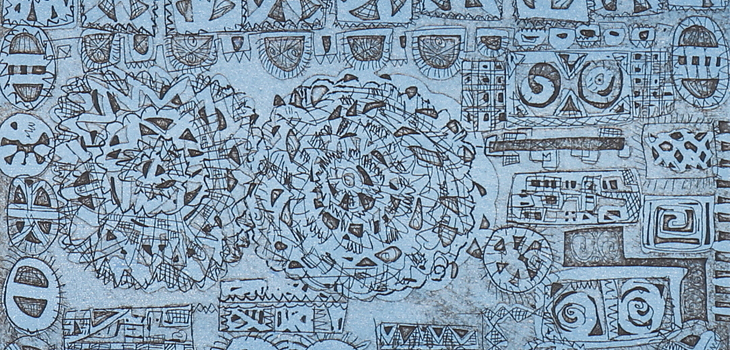
Berenice was a true Renaissance woman. Her practice transcended the strict boundaries of visual art. For Berenice, dance, music and literature were as much a part of what she did as her painting. It is perhaps for this reason that her art has been somewhat overlooked in the traditional surveys of 20th century British Art. And yet the art she produced is accomplished, with roots and influences from both European modernism, American expressionism and British Op-Art of the 1960s. It feels as fresh and relevant today as it did fifty years ago.
She was a prolific artist who produced a substantial body of work from 1964 until her tragically premature death in 1983. Her oeuvre consists of paintings on canvas, drawings, prints, children's books, costume design, and performance.
During the early years in her studio in Chelsea, Berenice experimented with figurative painting and her early endeavours owe much to the work of Picasso and Matisse with their lyrical lines playing on the boundaries of abstraction. At the same time, Berenice was beginning her life-long love affair with the printed form. A trip to Greece had inspired a series of stylised figurative linocuts which once again spoke of a link to more European artistic traditions. These early prints paved the way for further experimentation and over the years, she broadened her practice into lithography, etching, monoprints and screenprinting to great acclaim and she practiced print-making techniques at Hugh Stoneman's renowned studio in Islington. In fact, Berenice’s printed oeuvre is some of her most successful and proficient work.
Whilst Berenice’s career may have started with the figurative, it certainly was not to be an end in itself. She soon realised that figures were not needed as a starting point and that colour alone could provide everything she needed. From that point on, she was fascinated with the exploration of colour and perpetual movement and her paintings began to move more and more towards a point of total abstraction. She always limited herself to a palette of six colours when working on a canvas and described this as her ‘magic number. She enjoyed exploring the relationship between colours and found that each had their own personalities, ‘some colours are nasty, some friendly and some have little character’.
Berenice was precise in her working and would spend at least one month on every canvas using two flat brushes, one large and one small, to apply the colours as if neighbours beside one another. She always started painting her large canvasses from the middle from where she could build the journey of ‘contained colour’ in every direction and radiating outwards. These paintings have often been compared to the later work of Bridget Riley. Developed in series, often based on organic forms such as leaves, Berenice used colour in vortex-like compositions imbuing the paintings with a perception of movement.
At the same time, and typical of Berenice’s sense of fun and vibrancy for life, she was mesmerised by the way colour could also inject her work with humour. She strove to construct a world of visual humour by creating joy and laughter through her works. She stated ‘I would like to feel that the humour in my work will not be overlooked, that sometimes witty interaction between shaped colours on the canvas will be observed and that the fun in some of my prints occasionally indicated by the title will be enjoyed’.
Whilst her career has gone rather unnoticed in recent years, she was held in high esteem during her lifetime. At her funeral, an opera singer sang whilst her coffin was being lowered and the eulogy was read by Lord McAlpine, himself an avid and influential art collector. Her work is in over 100 public and private collections and during her lifetime, she participated in over forty exhibitions. Between 1963 and 1975 she appeared in ten group shows and eleven solo exhibitions. In 1974, she was invited to represent Britain at the Biennale della Grafica d’Arte in Florence and the following year, she exhibited a series of ‘stained-glass’ effect paintings at the Ashmolean Museum in Oxford.
She is buried in Highgate Cemetery and listed as one of the notable people to be buried there.
Berenice Sydney was a passionate and exotic character whose personality truly dances across her canvasses. In her own words: "ARS LONGA VITA BREVIS
– LIFE FAILS BUT ART PREVAILS". BERENICE SYDNEY