Eric William Ravilious grew up amidst the gentle hills and storied coastlines of Sussex, a landscape that would later become central to his art. Born in Acton, London, and raised in Eastbourne, Ravilious found daily inspiration in the rural scenery surrounding his family’s antiques shop. His artistic journey began at Eastbourne School of Art and flourished at the Royal College of Art in London, where formative friendships, especially with Edward Bawden, and mentorship under Paul Nash honed his fascination with experimental landscape and wood engraving. A pivotal scholarship to Italy in 1925 expanded his appreciation for light and form, enriching the pictorial vocabulary that would define his career.
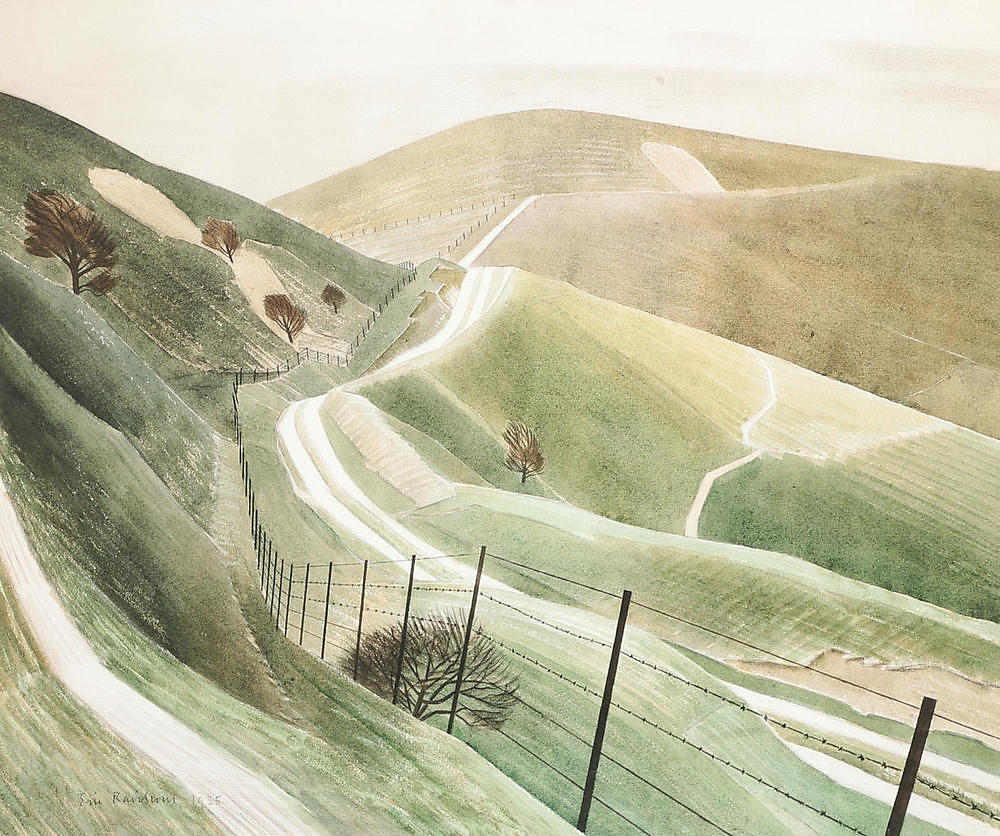
"The Sussex Downs", clubbed for 325 GBP at Lawrences Auctioneers.
Landscapes Transformed: A Modernist Language
Ravilious’s creative identity emerged through his refined watercolours of the English countryside, particularly the South Downs and quiet village scenes marked by enigmatic compositions. His signature style bridges the clarity of modernism with a poetic restraint, a “romantic modernism” realized through luminous yet subdued palettes and careful cross-hatching. Rather than idealizing the pastoral, he frequently foregrounded mundane machinery and everyday objects, rendering them with a near-abstract rhythm while always honoring the tangible world. Trained in both illustration and printmaking, Ravilious orchestrated his scenes with designerly precision: patterns, forms, and lines find a balance that is at once rational and magical, familiar yet quietly surreal.
The Art of Witness: War, Loss, and Enduring Influence
As one of Britain’s first official war artists in the Second World War, Ravilious brought his restrained yet vivid vision to the era’s stark new realities, airfields, ships, and coastlines documented in watercolours as coolly observant as they are subtly haunting. His life was tragically cut short in 1942, lost on an air-sea rescue mission near Iceland, yet his legacy resonates powerfully. Ravilious’s art endures as a testament to modernist innovation and the enduring beauty, and strangeness, of the English landscape, continuing to inspire generations with its clear-eyed wonder and quiet imagination.