Yasse Tabuchi was born in Japan and grew up surrounded by the rich visual traditions of his homeland, from classical ink painting to the refined aesthetics of calligraphy and printmaking. His early training was rooted in these traditions, but his artistic ambitions led him beyond Japan. In 1951, Tabuchi moved to France, settling in Paris at a time when the city was a global hub for modern art. Immersed in this dynamic cultural environment, he encountered European avant-garde movements and developed an artistic language that fused Japanese sensibility with Western abstraction.
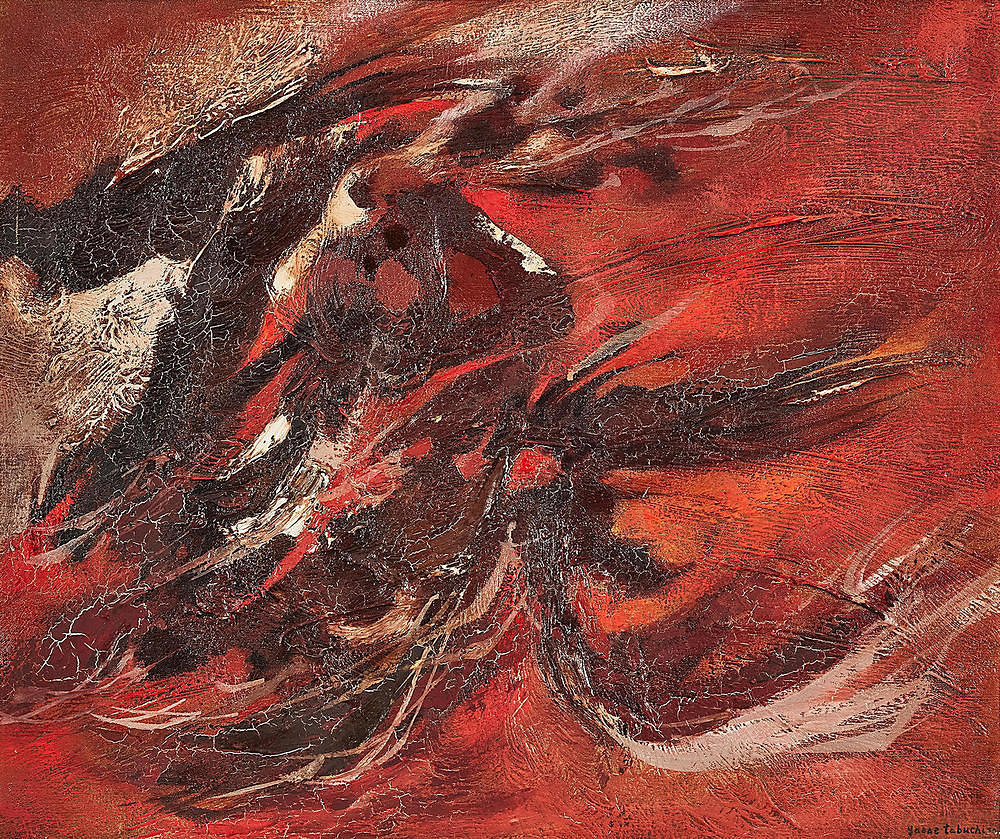
"Braise dans le champ", clubbed for 2 015 GBP at Stockholms Auktionsverk.
From Abstract Landscapes to Mystical Abstraction
Tabuchi’s paintings often combined organic shapes, fluid lines, and layered colour fields, suggesting landscapes, cosmic visions, or dreamlike interiors. He employed techniques that created depth and texture, sometimes incorporating gestural brushwork reminiscent of calligraphy. His compositions balanced spontaneity with structure, resulting in works that felt both intuitive and deliberate. Over time, his art shifted further toward pure abstraction, yet it retained a lyrical quality that evoked nature, spirituality, and the unseen forces of the world. This blending of Eastern and Western approaches gave his work a distinctive voice in the post-war abstract movement.
Recognition and Lasting Influence
Tabuchi exhibited widely in Europe, Japan, and beyond, participating in significant international exhibitions and earning acclaim from critics and collectors alike. His works are represented in major museums and public collections, appreciated for their harmonious fusion of cultural traditions and innovative abstraction. Throughout his career, Tabuchi remained committed to exploring painting as a meditative, transformative process. Today, he is remembered as a bridge between worlds, an artist whose work speaks across cultures, uniting the precision and spiritual depth of Japanese art with the bold experimentation of European modernism.