Eve Eriksson was a Swedish artist born in Löderup on Österlen. Alongside his friend Hans Billgren (1910-1985), Eriksson proved that artistic energy can be found anywhere. He received his education during the 1930s at Axel Smith's painting school in Copenhagen, among other places. Over the next two decades, he lived a nomadic life, residing alternately in Spain, Copenhagen, Norrland, Löderup, and Stockholm, before settling in Malmö in 1960, where he lived until his death in 1992. Eriksson's art is considered among the most personal and distinctive in 20th-century Swedish art, largely due to his relentless pursuit of his own unique artistic language rather than a single style.
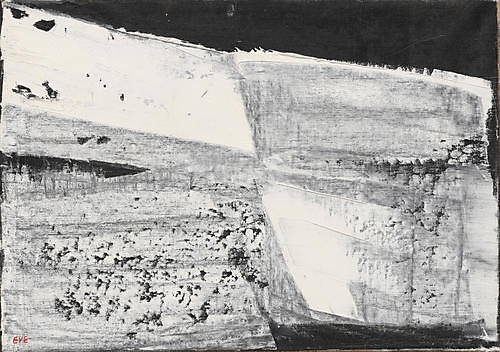
Oil on canvas, clubbed for 479 GBP at Crafoord Auktioner Malmö.
A Constantly Evolving Artist
Eriksson's career was marked by continuous evolution. He held his first solo exhibition in 1940 at De unga in Stockholm and exhibited consistently throughout his life. His work was often well-received by critics and sold successfully, but after his death, his art largely fell into obscurity. This is surprising given the originality of his work. Unlike many artists who settle on a signature style, Eriksson unapologetically switched between expressions, always maintaining a common thread of unique self-expression. Just before his death, he experienced a major retrospective exhibition at Lunds Konsthall, a testament to his enduring quality and a final celebration of his versatile career.
An "artist's artist."
Among his peers, Eve Eriksson was considered an "artist's artist." He earned the admiration of fellow artists, including the acclaimed Torsten Andersson, who valued an artist's ability to find their own language above all else. This admiration highlights Eriksson's significant contribution to the art world, his fearless individuality. It wasn't until 2010 that Kristianstad Konsthall held a separate exhibition dedicated to his work, once again bringing his artistry to public attention. Eriksson is well-represented in several prominent Swedish museums, including the Nationalmuseum, Moderna Museet, and Malmö Konstmuseum, ensuring that his legacy as a unique and influential figure in Swedish art history will not be forgotten.