Nils Forsberg was born in Riseberga, Sweden, into modest circumstances. He began his working life as a house painter, honing his craft on walls and furniture rather than canvases. His raw talent, however, was evident, and with the help of local patrons he secured a scholarship to study in Paris. At the École des Beaux-Arts, Forsberg trained under the eminent French academic painter Léon Bonnat. This exposure to rigorous academic instruction, combined with the cultural richness of Paris, transformed his artistic ambitions and introduced him to the grand tradition of European history painting.
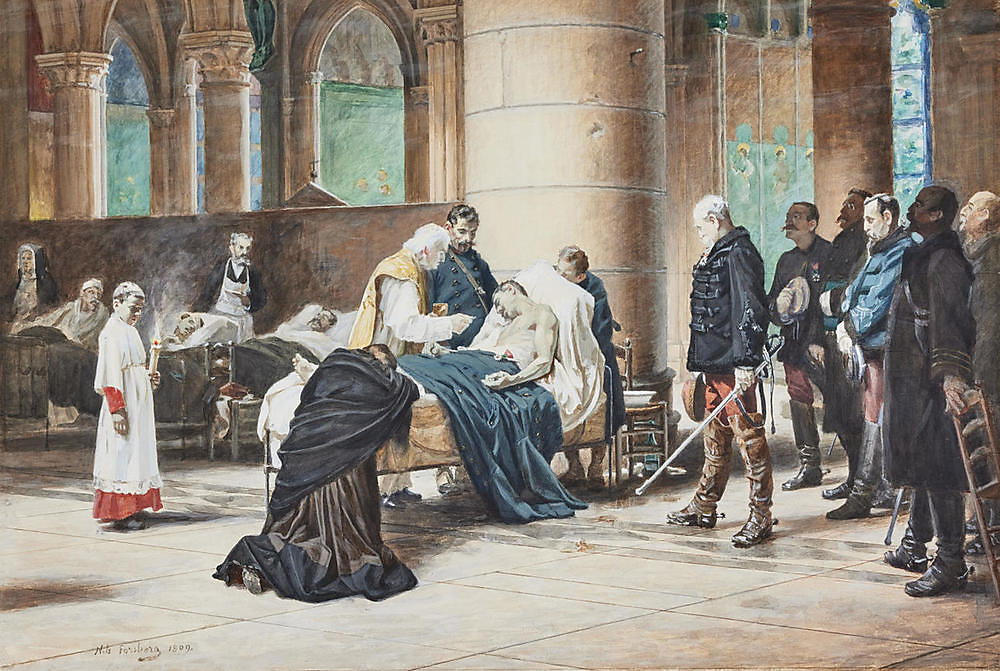
“Death of a Hero”, clubbed for 2 630 GBP at Stockholms Auktionsverk.
Historical Narratives and Social Commentary
Forsberg became renowned for large-scale historical paintings and moralising genre scenes, often imbued with a strong sense of patriotism and social conscience. His works balanced dramatic composition with realistic detail, depicting pivotal events with an intensity that invited both admiration and reflection. Paintings such as Death of a Hero reveal his ability to combine narrative clarity with emotional weight, ensuring that viewers felt both the grandeur and the human cost of history. His genre works, meanwhile, portrayed everyday life with empathy, focusing on the dignity of ordinary people.
Recognition and Lasting Legacy
Forsberg exhibited widely in France, Sweden, and other parts of Europe, earning numerous awards, including the French Legion of Honour. His career exemplified the international reach that a Swedish artist could achieve in the late 19th century. Today, his paintings are held in prominent institutions such as the Nationalmuseum in Stockholm, where they are valued for their technical excellence and historical resonance. Forsberg’s art reflects a belief in the power of painting to educate, inspire, and preserve collective memory. His legacy endures as that of a master storyteller whose brush brought both history and humanity vividly to life.