- Hammerslags- og temaauktioner
- /
- Weapons & Militaria
Weapons & Militaria
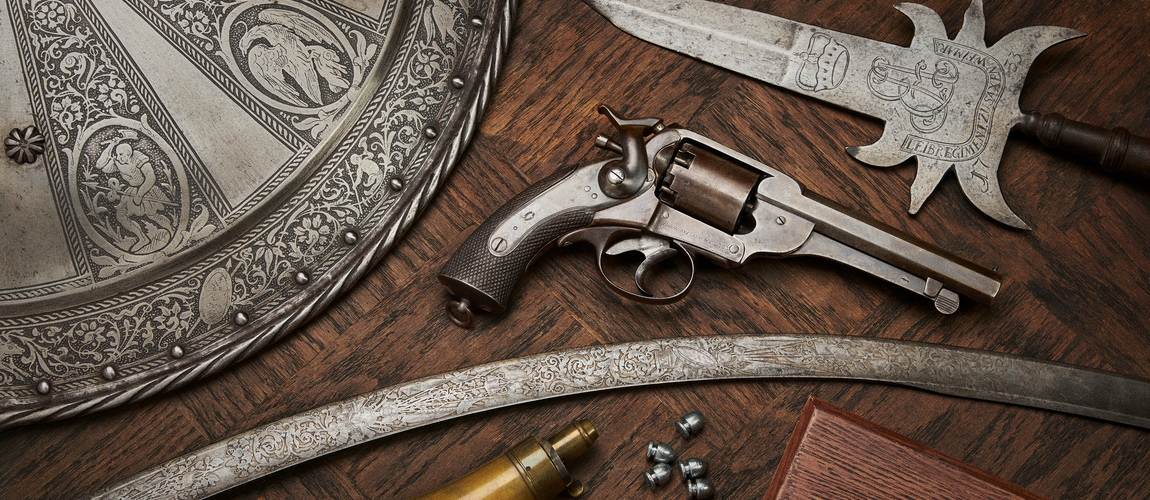
This autumn’s weapons and militaria sales serves, in many respects, as a tribute to the collector, the collection, and the act of collecting. Throughout history, the display of an exquisite and substantial armoury has been a way for the affluent to showcase their status—signaling wealth, power, and worldly sophistication. In Sweden, the armoury at Skokloster stands as the premier surviving example from the early modern period.
The focal point of the auction is a group of 15 items attributed to the well-known arms collection of the Swedish King Karl XV—a collection that was partially dispersed among various Swedish museums and partially sold off approximately a century ago. These 15 pieces exemplify the Central European ideals of the 16th and 17th centuries regarding how a soldier should be equipped. In its most recent iteration, this group formed part of the arms collection of the merchant Carl Wikström (1851–1920). One of the items—a German round shield—has a provenance distinct from that of King Charles XV. A yellowed slip of paper on its interior reveals that it was purchased in Dresden in 1907 and once belonged to the so-called Gimbel Collection. Karl Gimbel was something of a local celebrity in Baden-Baden during the latter half of the 19th century. A career military officer, Gimbel devoted himself increasingly to his historical interests upon his retirement; beyond being a historian, he was also a major collector of early modern German armour. When his collection was sold and dispersed following his death, several items—including this one—were acquired... ...this magnificent shield, acquired by an antique dealer named Louis Martin, based at Augustusstrasse 6 in Dresden. The entire history can be traced, all thanks to this modest, yellowed slip of paper. Breathtaking.
Charles XV is a major name, but Archduke Ferdinand II of Tyrol is an even greater one. The sword of German origin—also part of the Wikström collection—is of a type typically associated with the armoury at Ambras Castle in Austria. This collection was largely assembled by the castle’s builder, the aforementioned Archduke and Imperial Count of the Holy Roman Empire, Ferdinand II (1529–1595). While it is by no means certain that this specific sword originated at Ambras, it is certainly not impossible. In fact, if you give it some thought, it is actually quite plausible.
Anyway, enough about 16th-century Germany (if one can ever truly have enough of it?). The auction offers so much more: there are pistols with both flintlock and percussion mechanisms, as well as swords, sabers, and daggers. There is even a Model 1948 flight suit, once worn by a Swedish fighter pilot. As you can see, there is a little bit of everything.