Vi har desværre ingen genstande, der matcher din søgning.
- Hammerslags- og temaauktioner
- /
- Karl Erik Djup's Collection of Edged Weapons
Karl Erik Djup's Collection of Edged Weapons
FiltrerFiltrer og sorter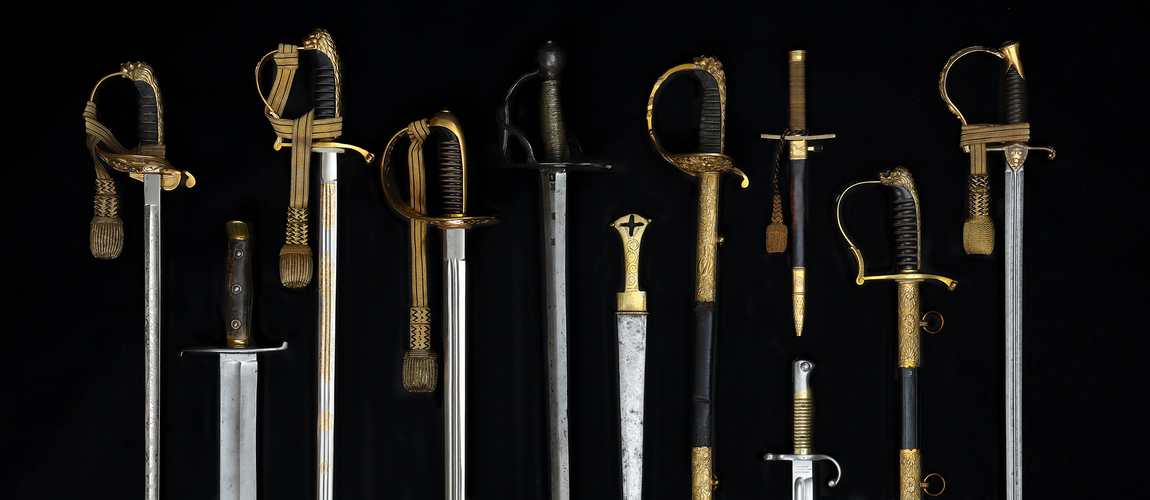
Karl Erik Djup's Collection of Edged Weapons
26 jun 2026 · Auktionsmagasinet Vänersborg
When pistols and rifles took over on the battlefields, military edged weapons lost their practical significance. But they lingered on for centuries as part of ceremonial uniforms — and for all those with an interest in the subject, sabres, swords, cutlasses, axes and bayonets hold an enduring fascination. Now Auktionsmagasinet Vänersborg has had the honour of selling Karl Erik Djup's Edged Weapons Collection!
Karl Erik Djup served as a military officer throughout his entire professional life. For many years he was employed at Skaraborgs flygflottilj F7 in Såtenäs. He had a deep interest in military history, and in particular in edged weapons.
At Auktionsmagasinet Vänersborg his collection is presented across 43 lots. Among the highlights is a regulation sword, m/1685. The model was widely used in the late 17th century and the early decades of the century that followed. It was later modified but remained in service all the way into the early 20th century. A sabre with scabbard, m/1893 for a cavalry officer, is also considered one of the anticipated highlights. Alongside these we find, among other things, a boarding axe m/1780, a dress dagger m/1930 for an air force officer, as well as a sword knot, a parade belt — and naturally some literature for those who wish to deepen their knowledge further.
Welcome!
A few notes: blankvapen translates most naturally as "edged weapons" or "cold steel weapons" in a military context. Kommissvärja I rendered as "regulation sword" — the standard issue officer's sword. Sticket is a type of dress dagger, and knutskärp is a sword knot (the decorative strap attached to a sword hilt). I also noted there appears to be a word missing in the original ("så är sablar..." seems to be missing a verb) — I completed the sense naturally in the translation.Karl Axel Djup served as a military officer throughout his entire professional life. For many years he was employed at Skaraborgs flygflottilj F7 in Såtenäs. He had a deep interest in military history, and in particular in edged weapons.
At Auktionsmagasinet Vänersborg his collection is presented across 43 lots. Among the highlights is a regulation sword, m/1685. The model was widely used in the late 17th century and the early decades of the century that followed. It was later modified but remained in service all the way into the early 20th century. A sabre with scabbard, m/1893 for a cavalry officer, is also considered one of the anticipated highlights. Alongside these we find, among other things, a boarding axe m/1780, a dress dagger m/1930 for an air force officer, as well as a sword knot, a parade belt — and naturally some literature for those who wish to deepen their knowledge further.
Welcome!
A few notes: blankvapen translates most naturally as "edged weapons" or "cold steel weapons" in a military context. Kommissvärja I rendered as "regulation sword" — the standard issue officer's sword. Sticket is a type of dress dagger, and knutskärp is a sword knot (the decorative strap attached to a sword hilt). I also noted there appears to be a word missing in the original ("så är sablar..." seems to be missing a verb) — I completed the sense naturally in the translation.
Igangværende auktioner
Her er genstande fra vores arkiv, der matcher din søgningVis alle genstande