Keith Murray was a pioneering New Zealand-born designer and artist, renowned for shaping the course of Art Deco ceramics, glassware, and industrial design in the twentieth century. Born in Auckland, he moved to Britain at just 14, carrying with him a keen interest in drawing, mechanics, and architecture. World War I had a profound impact on his life; Murray served bravely in the Royal Flying Corps and Royal Air Force, earning the Military Cross and Croix de Guerre. Returning to postwar London, he pursued architectural studies, drawing on his technical acuity and creative instincts. Amid the economic uncertainty of the interwar period, Murray’s resourcefulness led him from architecture to commercial illustration, and ultimately, decorative and industrial design.
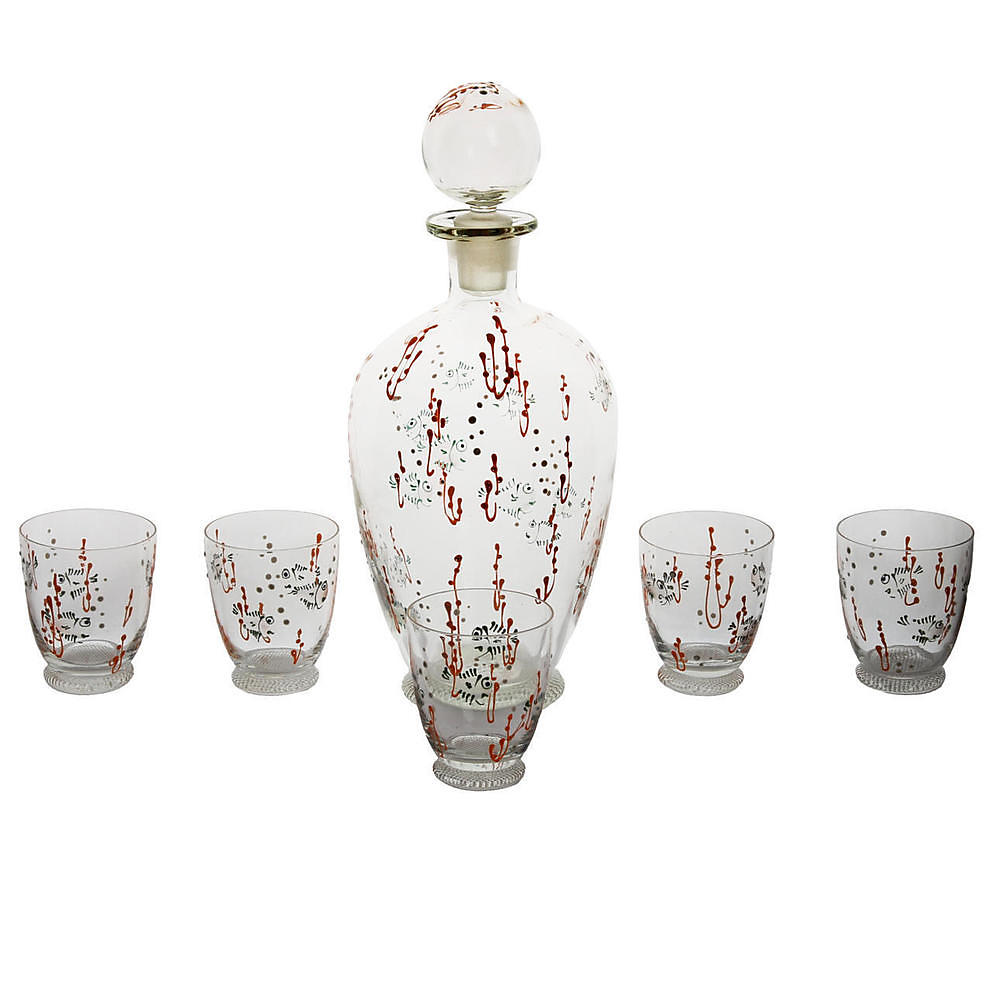
English decanter, clubbed for 25 GBP at Bishop & Miller.
Minimalism and Modernity: Transforming Wedgwood
Murray’s most influential phase began in the early 1930s when he joined Wedgwood as a designer. Embracing Art Deco’s spirit, he applied an architect’s eye to ceramics, prioritizing clean lines, geometric purity, and form over superfluous ornamentation. Muted glazes, subtle banding, and “architectural ribbing” became the hallmarks of his celebrated vases, bowls, and tableware. Murray’s modernist sensibility revitalized Wedgwood and elevated British decorative arts on the world stage, resonating with a growing middle-class audience searching for sophisticated, streamlined design. He collaborated widely, imprinting his minimalist vocabulary onto glass for Stevens & Williams and silver for Mappin & Webb, where conical and stepped forms became his signature.
Lasting Influence: The Enduring Legacy of Keith Murray
Keith Murray’s impact extended beyond ceramics and design. During and after World War II, he returned to architecture, designing the new Wedgwood Factory at Barlaston, airline hangars at Heathrow, and the original Hong Kong Kai Tak Airport terminal, projects revealing the same clarity evident in his design objects. An accomplished painter, Murray also depicted New Zealand’s landscapes, keeping alive his connection to his birthplace. Celebrated in major museum collections and exhibitions, Murray’s elegant minimalism and architectural precision have secured his place as a central figure in twentieth-century modernism, inspiring new generations of artists and collectors worldwide.