William Moorcroft emerged from the beating heart of England’s pottery industry in Burslem, Staffordshire, where creativity merged with tradition. Raised by his father Thomas, a respected ceramic artist, Moorcroft gained firsthand insight into design and production from a young age. Artistic studies in the local region as well as in London and Paris expanded his visual language. Entering the industry as an apprentice at Macintyre Art Pottery, Moorcroft refined his technical and creative prowess, earning recognition at James Macintyre & Co. There, he invented Aurelian Ware and, most notably, Florian Ware, a line that combined vivid color, lustrous glazes, and sinuous Art Nouveau motifs. The international accolades his designs garnered, including gold at the 1904 St. Louis International Exhibition–set him apart as a luminary within the Arts and Crafts movement.
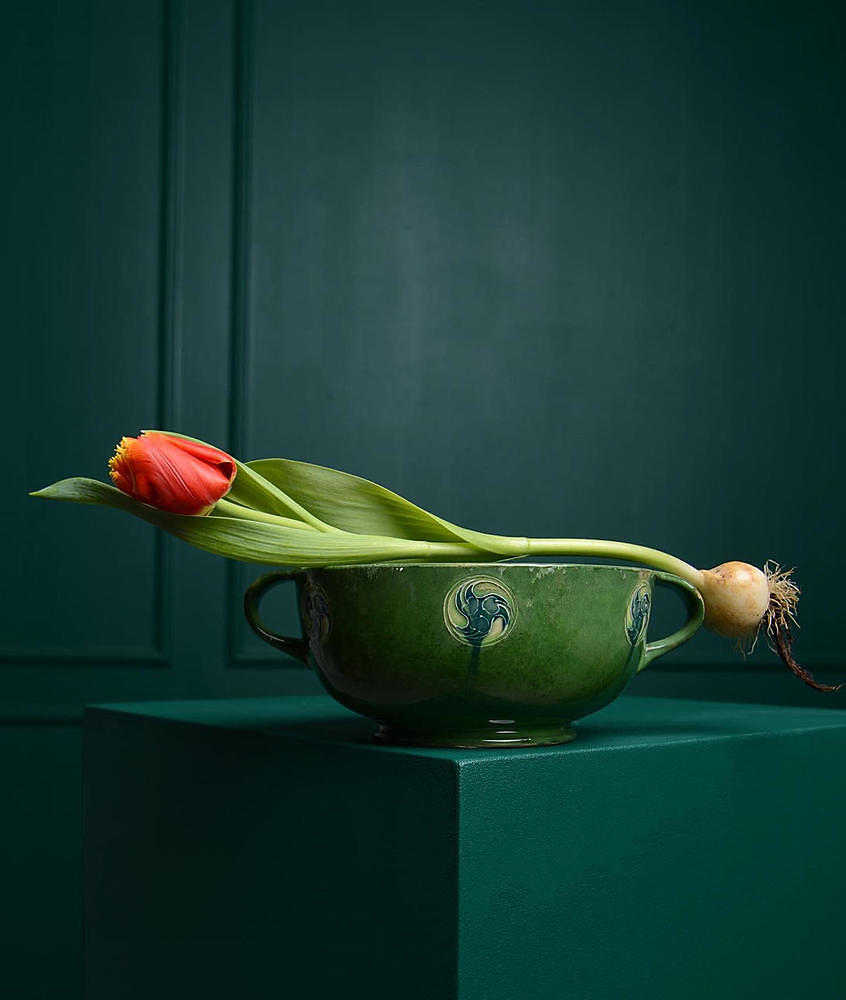
Bowl, "Green Flamminian", clubbed for 287 GBP at Formstad Auktioner.
Crafting Distinction: Innovation and Artistic Integrity
Moorcroft’s resolve to prioritize artistic vision led him to found his own pottery in Cobridge in 1913, supported by the esteemed retailer Liberty & Co. His distinctive ceramics, characterized by hand-painted, tubelined floral designs and brilliantly innovative glazes, soon captivated audiences nationwide and abroad. Moorcroft was uncompromising in quality, personally overseeing decoration and firing, particularly with his celebrated flambé wares, and frequently signing each object to guarantee authenticity. Bridging the worlds of studio and industrial pottery, he maintained creative control over every stage, an uncommon achievement that ensured both artistic purity and broad appeal.
Legacy of Excellence: Moorcroft’s Enduring Influence
Navigating decades of social and artistic change, Moorcroft preserved a core dedication to craftsmanship and inspired design. Signature ranges such as Pomegranate, Hazledene, Spanish, and Pansy epitomized his mature aesthetic, while the company’s Royal Warrant in 1928 crowned his reputation. Even his most ambitious pieces now hold pride of place in collections worldwide. Succeeded by his son Walter after his death in 1945, Moorcroft’s unique legacy, uniting artistry, innovation, and technical mastery, continues to inspire potters and collectors, remaining integral to the heritage of British decorative arts.