Fredrik Westin was born in Sweden at a time when the country was closely aligned with the neoclassical ideals dominating European art. Recognised early for his talent, Westin studied at the Royal Swedish Academy of Fine Arts in Stockholm, where he excelled in drawing, anatomy, and historical painting. His early achievements earned him scholarships to study abroad, and he travelled to Paris and Rome, two of the most important centres for art education in the early 19th century. These experiences exposed him to classical antiquities, Renaissance masters, and contemporary European painters, all of which would deeply influence his style.
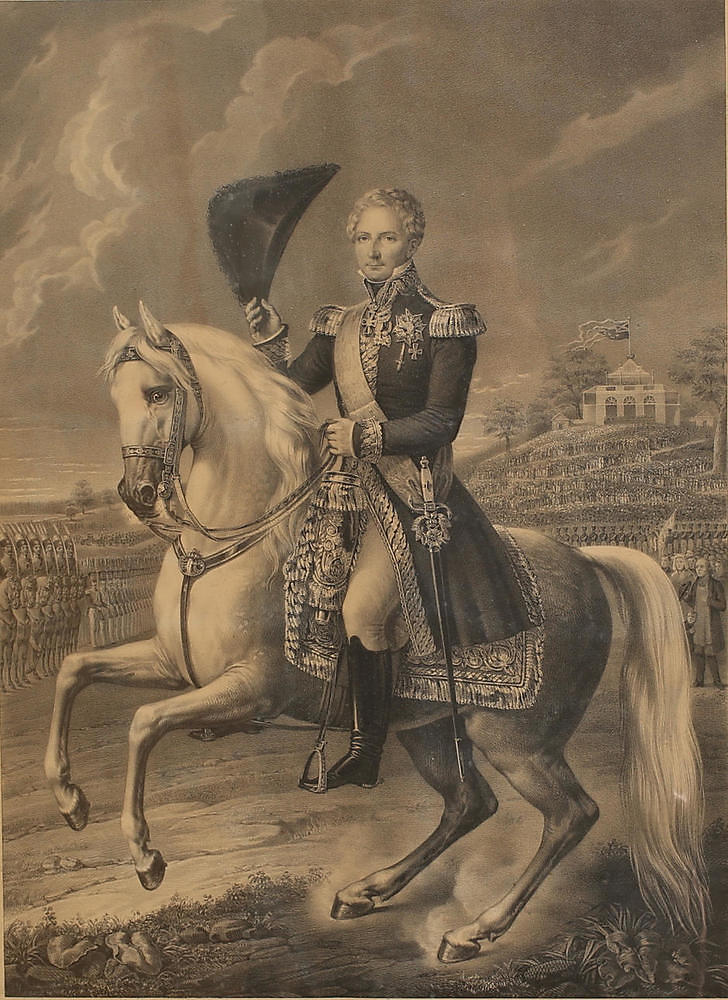
"Karl XIV Johan King of Sweden and Norway", clubbed for 582 GBP at RA Auktionsverket Norrköping.
Historical Painter and Court Artist
Westin became best known for his grand historical compositions, portraits, and religious paintings. His works reflected the academic emphasis on clarity, balanced composition, and moral or heroic themes. Appointed court painter to the Swedish monarchy, he produced portraits of royalty and nobility, ensuring his place among the country’s most respected artists of his time. His religious paintings, many commissioned for churches, demonstrated a mastery of dramatic lighting and dignified figure arrangements, aligning with the ideals of moral instruction and civic pride that defined the era’s art.
Educator, Influence, and Legacy
Beyond his painting career, Westin played a significant role as an educator. As a professor and later director at the Royal Swedish Academy, he trained and influenced a generation of Swedish artists. His leadership reinforced the academic traditions that shaped Swedish art in the 19th century. While later artistic movements would move away from the strict formality of his approach, Westin’s work remains valued for its technical excellence, historical importance, and contribution to Sweden’s cultural heritage. Today, his paintings can be found in national museums, churches, and royal collections, preserving his legacy as a central figure in Swedish academic art.