Filip Månsson was a multifaceted Swedish artist, decorator, and etcher. His artistic journey began with a hands-on apprenticeship with his father, painter Karl Fredrik Månsson, and other master painters in Stockholm. He later pursued formal education at the Technical School in Stockholm and the Royal Academy of Fine Arts. During his student years, Månsson took a pivotal study trip to Finland, where he was profoundly influenced by the Morris movement. This exposure to international decorative art trends, along with a subsequent trip to England, shaped his unique style and set him on a path to become one of Stockholm's most sought-after decorators.
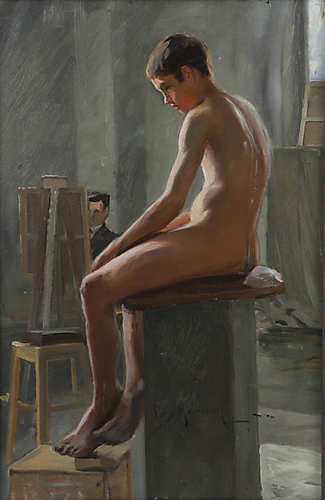
Model study with young man, oil on canvas, clubbed for 183 GBP at Stockholms Auktionsverk.
A Master of Techniques
Månsson was renowned for his decorative works, particularly his mastery of fresco painting and other traditional craftsmanship techniques. He established his own studio in Gamla stan (Old Town) in Stockholm and quickly gained a reputation for reviving old traditions while infusing them with his own innovative vision. His style was highly individual, characterized by a fusion of oriental arabesques and elements from pre-Protestant church paintings. His work often featured stylized designs that covered large areas and incorporated animal motifs. Beyond his artistic output, Månsson also dedicated himself to teaching, running a private painting school in the 1920s and holding a position at the Technical School in Stockholm, passing his knowledge to a new generation.
Career Highlights and Legacy
Filip Månsson's talent and contributions to Swedish art were recognized both critically and institutionally. He was elected as a member of the Royal Academy of Fine Arts in 1924, a significant honor that acknowledged his skill and influence. While his legacy is most visible in the decorative murals and frescoes in buildings, his works are also represented in public collections, including the Malmö Museum and the Archive of Decorative Arts in Lund. His career demonstrates a unique blend of traditional craftsmanship and modern artistic sensibilities, establishing him as a key figure in the Swedish Art Nouveau movement and a bridge between classical techniques and early 20th-century decorative art.