Vi har desværre ingen genstande, der matcher din søgning.
- Hammerslags- og temaauktioner
- /
- Marquetry
- /
- Øvrigt
- /
- Øvrigt
Marquetry
FiltrerFiltrer og sorter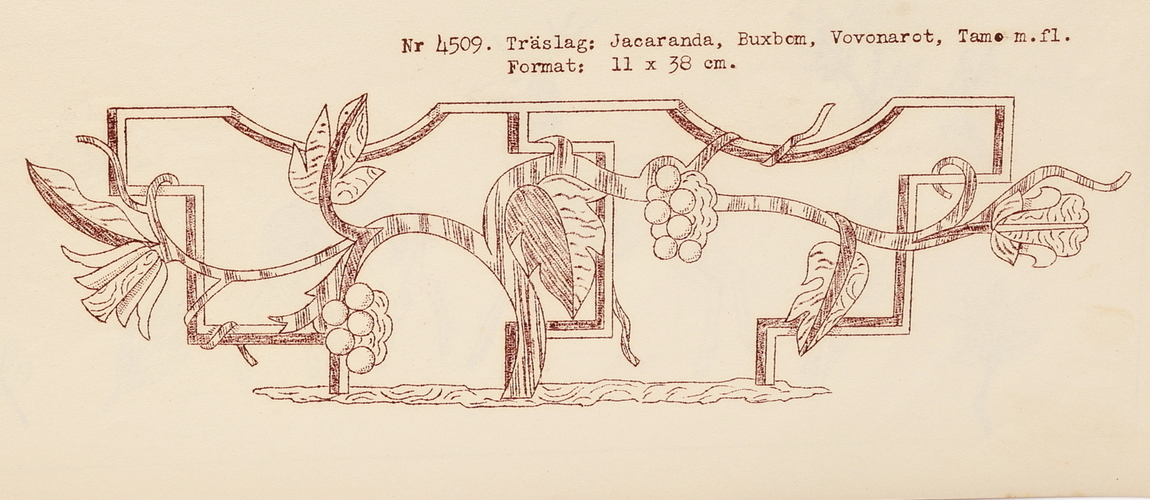
Marquetry
4 jul 2026 · Gomér & Andersson Linköping
Gomér & Andersson Linköping takes us back to "the renaissance of wood in interior architecture" — to a 1930s world where the art of marquetry flourishes, bringing monks, wine jugs in wicker baskets, and celebrated allegories into Swedish decorative arts. All executed in exotic woods.
If we are to believe interior architect Perry Marthin (whose words we borrow here), the art of marquetry was on the verge of dying out by the mid-1920s. But with the following decade's abundance of pared-down furniture — free from curling ornaments and eye-catching carvings — room was made for artistic storytelling and a high degree of craftsmanship.
As a central hub for this art form, Mjölby emerges. There, motifs and patterns were created and offered either as finished products or as decorative elements for items from Swedish furniture manufacturers. Several significant interior commissions include large marquetry works from Mjölby.
At Gomér & Andersson Linköping we are treated to a representative taste of what was achieved during the 1930s and 1940s. Alongside the trays, mantel clocks and wall sconces, we also find a pair of catalogues and even some original sketches by Birger Ekman, who for a number of years in the 1930s served as artistic director at Mjölby Intarsia.
A warm welcome to this admirably cohesive theme!
P.S. Would you like to know two curious facts about Perry Marthin? Here they are: He worked for a time as an interior architect at Gustaf Axel Berg, and in the later part of his career he became a qualified colour consultant with the International Association of Color Consultants in Salzburg.
Igangværende auktioner
Her er genstande fra vores arkiv, der matcher din søgningVis alle genstande