Meillä ei valitettavasti ole hakuasi vastaavia esineitä.
- Teema- ja vasarahuutokaupat
- /
- Agnes Karlsson's Collection: A life in the service of Gustavsberg
- /
- Keramiikka ja posliini
Agnes Karlsson's Collection: A life in the service of Gustavsberg
SuodataSuodata ja lajittele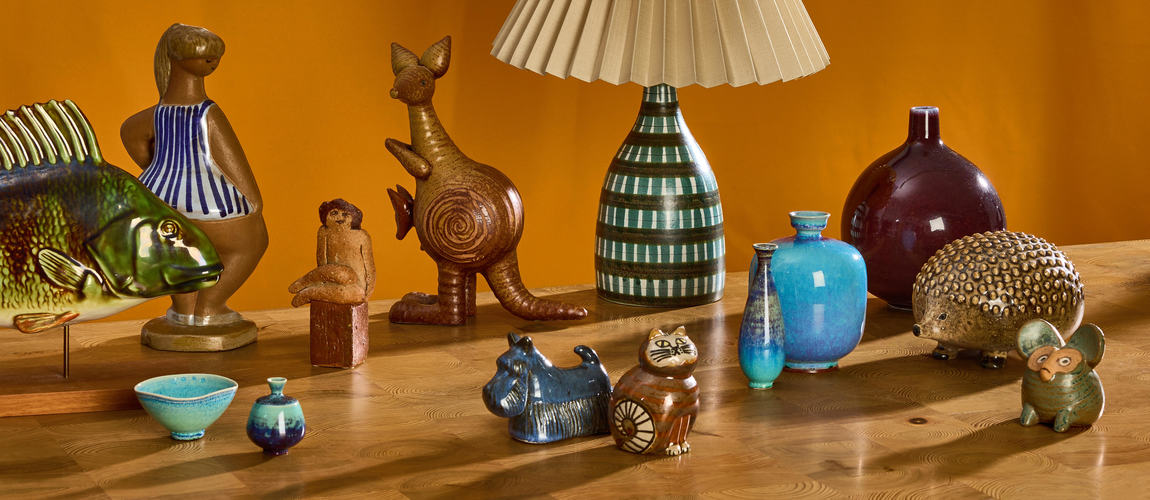
Agnes Karlsson's Collection: A life in the service of Gustavsberg
19 loka 2025 · Crafoord Auktioner Stockholm
Agnes Karlsson was something of a legend in Gustavsberg—both in the community and in the porcelain factory. She grew up just steps from the factory that would so early on shape her everyday life. The family was deeply rooted in Gustavsberg, where streets still bear its name.
Agnes was a woman of principle, meticulous and firmly assured in her opinions. Nothing escaped her scrutinizing eye.
“You know where it stood, don’t you?” she might ask her grandchildren with a slightly admonishing undertone if they had moved a candlestick from the mantelpiece to the dining table. Everything had its rightful place. The silverware was polished once a year, in the spring. The well-stocked cabinet of fine porcelain was a no-go zone for the rest of the family.
It was only natural that Agnes Karlsson devoted her working life to the Gustavsberg porcelain factory, or bruket as it was locally called. She started as a teenager straight after school and contributed significantly to the factory’s development, where Karin Björquist, Lisa Larson, Wilhelm Kåge, Stig Lindberg, and Berndt Friberg were among the many celebrated artists and designers. Agnes printed motifs on porcelain and excelled in the role of quality inspector—to the point that a foreman banished her to the warehouse when too much began being rejected as second-rate. She maintained a long-standing collaboration with Lisa Larson in her studio, assisting with everything from production to exhibition arrangements, and ensuring that the coffee was always good. Agnes was also the one who looked after apprentices and introduced new employees from Finland, Italy, and the Balkans to the inner workings of the factory.
When Agnes and her husband Tore drove their Volvo Duett to the Domus department store to line up for the introductory offer on a lamp in the Gustavsberg Blå Blom series, it highlighted two truths: circumstances were modest, so one had to seize opportunities when they arose—and one made do with what was at hand. Over time, an extraordinarily comprehensive collection of Gustavsberg ceramics and porcelain grew out of this way of life.
Crafoord Stockholm is now proud to present Agnes Karlsson’s life’s work: a collection that spans everything from everyday series to limited editions and unique pieces by Gustavsberg’s foremost artists and designers—not least a wide spectrum of Lisa Larson’s works.
From the first brickworks in the 17th century to the takeover by the Swedish Cooperative Union in 1937, Gustavsberg developed into a model modern community. It is within this context that the collection finds its roots and tells the story of an entire working life at the heart of Sweden’s formidable history of arts and crafts.
Käynnissä olevat huutokaupat
Tässä ovat arkistossamme olevat esineet, jotka vastaavat hakuasiNäytä kaikki esineet